Small-town Professors. Faculty members at elite institutions like this one are commonly thought of as a sleek breed. But their origins sometimes are, or at least were, humble, and far from cutting-edge. Two memorial minutes presented to the Faculty of Arts and Sciences at its October meeting offered charming examples.
The late Raymond L. Erikson, American Cancer Society professor of cellular and developmental biology emeritus (a towering researcher on cancer virology and tumor formation) was, we learned, a farm boy at heart. He “was born on a Wisconsin dairy farm in 1936 and grew up near the village of Eagle that had been settled by his father and grandfather in the early 1900s.” His early education, in his words, was not “propitious,” as he attended a one-room schoolhouse—with one first-grade classmate. At the height of his scholarly powers, “he could frequently be found working at the bench Saturday mornings.” But science aside, he spent “two weeks each summer back in Wisconsin, when he returned to the family farm so that his brother could take a vacation.”
As for the late Dante Michele Della Terza, Babbitt professor of comparative literature emeritus, he “grew up in the town of Sant’Angelo dei Lombardi, about 60 miles east of Naples.” (The town was leveled in a 1980 earthquake; he visited after, but never returned to live there following his Harvard retirement in 1994.) His parents were an electrician and a homemaker. Much admired as a teacher, “In his classes, to avoid distracting students with his prodigious memory, he pretended to read Dante, Petrarch, Tasso, and Leopardi, which he knew by heart.” Navigating the modern world, he was less proficient in several ways: “He was…vastly more skillful verbally than ambulatorily. The story of his plunge into Venice’s Canal Grande while attempting to board a vaporetto… is legendary.” Nearer home, in Arlington, Massachusetts, or in his Widener study, it was rumored that “he never learned to type. We know that he never touched a computer or wrote an email. Neither did he ever learn to drive: his only attempt, in Paris, was a disaster. So, he wrote by hand and took buses”—and still managed to be a venerated scholarly colleague and adviser.
Concentration census. In an effort to understand the academic undergraduate mind, Primus was pleased to learn that the number of concentrators in each field is available among the College’s online resources. What used to be the “Fields of Concentration”—and is now https://handbook.college.harvard.edu/files/collegehandbook/files/fields…—yields, at the end of each field, a running count of concentrators. No surprise, the number in comp lit halved from 2011 to 2019 (2020 data being noisy, given the pandemic), from 40 to 20, and in English, from 164 to 88, as the ranks of the budding computer scientists swelled from 146 to 407. Econ held its own, 616 to 612, but government declined from 465 to to 313—perhaps mirroring the woes of the larger society.
If Primus were picking a concentration today, and wanted to have a superb faculty practically to himself, he would go for classics, perhaps (24 concentrators in 2019), or philosophy (58, interestingly all but unchanged from 2011). And he would puzzle about the decline in many of the core sciences, too, even as the applied mathematicians (up more than 100, to 299), statisticians (up more than twofold, to 136), and coders increasingly rule the roost.
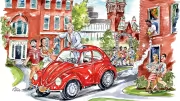
The presidents. Cynthia Rossano, whom many Harvardians know only from her learned essay in the Commencement Morning Exercises program, explaining the rituals, regalia, and rigmarole, took advantage of the pandemic to craft a little book on the University’s leaders. An avid Harvard historian, she has created a flip-book, with two front covers, one each for Harvard’s and for Radcliffe’s presidents. Within are delightful leaderly tidbits, illustrated by Mark Steele, who continues to amuse in this magazine’s “Yesterday’s News” columns. Former University printer Daniel J. McCarron was an adviser and guiding spirit. You can find the volume at Harvard Book Store.