

Speaking to Harvard’s 19 ROTC graduates on May 27, retired U.S. Air Force Lieutenant General Richard Clark told them a story he’s not too proud of.
In 2008, as a colonel deployed in Iraq, he was the director of the Joint Interagency Task Force-Iraq Multi-National Force-Iraq, Baghdad. It was the hardest year of his life—and the most meaningful. When he finally got to take a leave, he was so eager to be heading home that he relieved himself of duties immediately. At the Baghdad International Airport, where as the senior officer Clark was responsible for the aircraft’s passengers, he instead delegated that duty to an airman at the operations desk.
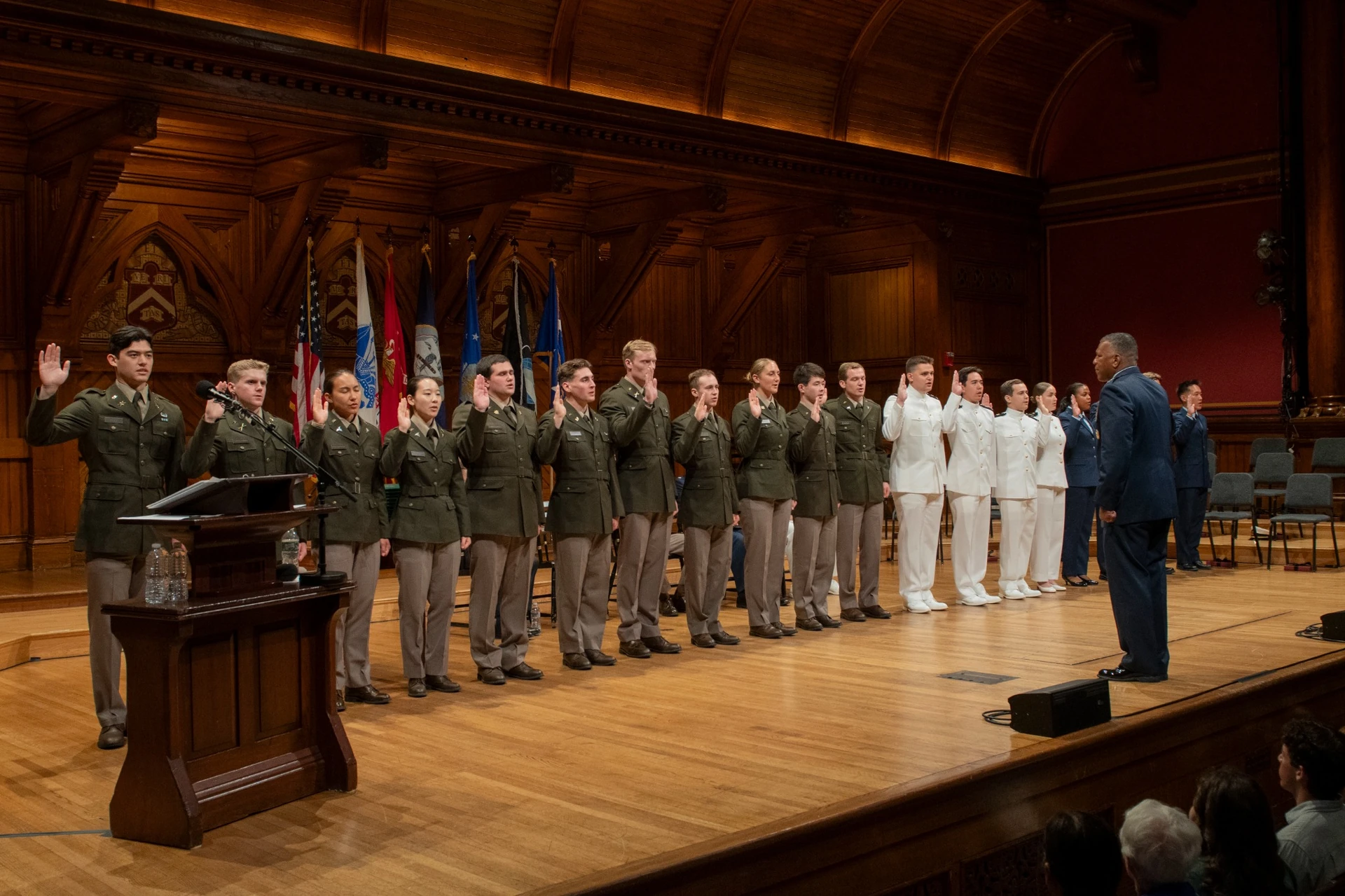
But the plane was delayed by needed repairs. Clark, who kept asking those in charge when things would be fixed, was finally urged to wait in the “distinguished visitor lounge.” There, Clark sat around, gladly snacking and watching television until the plane was ready. That scenario repeated itself at the next stop, in Mosel, where the lounge food was even better. Finally, when the group readied to board another plane, Clark was perturbed that only one entrance was available. “Hey, why didn’t you guys open up the back?” he asked. “We could have already been on here.” He strode on board, first in line. And there, at the back, were two coffins draped with flags. “As soon as I saw them, I just felt this sense of dread, like, ‘What a jerk I am,’” he told the graduating seniors and their friends and families packed into Sanders Theatre. “What a poor leader. What an anti-everything that I said I was going to be.”
During the flight, he sat with the coffins. “And I got to think about myself and what kind of leader I had been that day and my choice to not lead,” Clark said. The people in those coffins had “given everything—everything—and I couldn’t even make it through one more day of leadership.” “Never again,” he told himself. “Never again will I choose not to lead.”
Clark is a decorated 38-year U.S. Air Force veteran. He served three combat tours as a command fighter pilot and performed in other roles, earning the Distinguished Service Medal and Distinguished Flying Cross. In 2018, he became the U.S. Air Force deputy chief of staff for strategic deterrence and nuclear integration at the Pentagon before taking the helm as superintendent of the U.S. Air Force Academy in 2020, retiring from the military four years later. (Currently, he is the executive director of the College Football Playoff.) Among those in Sanders Theatre that day, graduating from Harvard and ROTC, was his daughter, Zoë Clark ’26, who was commissioned into the U.S. Air Force as a contracting officer. (His son, Milo Clark ’24, also an ROTC graduate, was in the audience, too.)
Clark strode around the stage as he spoke, without a script, microphone in hand, seemingly totally at ease, yet serious. He contrasted his 2008 experience with the choices made by Harvard graduate Sherrod E. Skinner Jr. ’51, a Korean War artillery observer.
Second Lieutenant Skinner also completed the Marine Corps Reserve Platoon Leaders program, and by the fall of 1952 was serving in the 11th Marines, 1st Marine Division, in charge of a vital frontline outpost. With enemy soldiers on the attack, he was told to hold the line, and that reinforcements were coming. Despite being wounded twice, Skinner left the bunker to direct machine-gun fire and to replenish supplies. Eventually, though, the U.S. Marines “were out of ammunition, reinforcements hadn’t arrived, they were cut off communications,” Clark said, “and the enemy had broken through the line.” As a last resort, Skinner ordered the men to “play dead” inside the bunker. “The enemy came in, looked around, saw a bunch of Marines laying on the ground…and to ensure there were no survivors, they threw a grenade in,” said Clark. “Lieutenant Skinner saw that grenade land between him and two of his men and, without hesitation, he jumped on it. He took the explosion himself to save his men.”
Lieutenant Skinner had been three days shy of his 23rd birthday. Yet he knew what it meant “to hold the line,” Clark continued. “He knew what it meant to commit to something bigger than himself.” In 1953, Skinner was posthumously awarded the Congressional Medal of Honor for “conspicuous gallantry and intrepidity in action beyond the call of duty.”
When Clark hears stories like that, he asks, “What would I do? Could I do that? What were the values instilled in him that made him do what needed to be done?” For Clark, those essential values have become clear: integrity, humility, and excellence. Integrity means “exhibiting and executing actions that are aligned with your morals, ethics, and commitments.” Humility is about “lifting up others before yourself.” We all know organizations where “people climb on the backs of others to get to the top,” he said. “But humility is about helping your teammates be their best possible selves.” And excellence? “Always elevating your performance,” he said. “It doesn’t mean that you’re the best or that you’re at the top. It’s about a mindset; every day [you’re] saying, ‘I’m going to be better today than I was yesterday.’”
In short: “Live honorably. Lift others. Elevate performance. Those are the actions of a man, of a woman, of character,” Clark told the crowd, adding that on that day in 2008, “those were not my values.” Lieutenant Skinner and Colonel Clark, he added, “both made choices.” Use their stories, he instructed the assembled graduates, to decide “how you’re going to lead for the rest of your time in the military, and the rest of your life—because leadership is not confined to the military.” He continued, “Leadership is everywhere you go, everything you make. Every time you meet someone, you have the chance to live honorably, to lift others, and elevate performance. Choose your values and live them every day.”
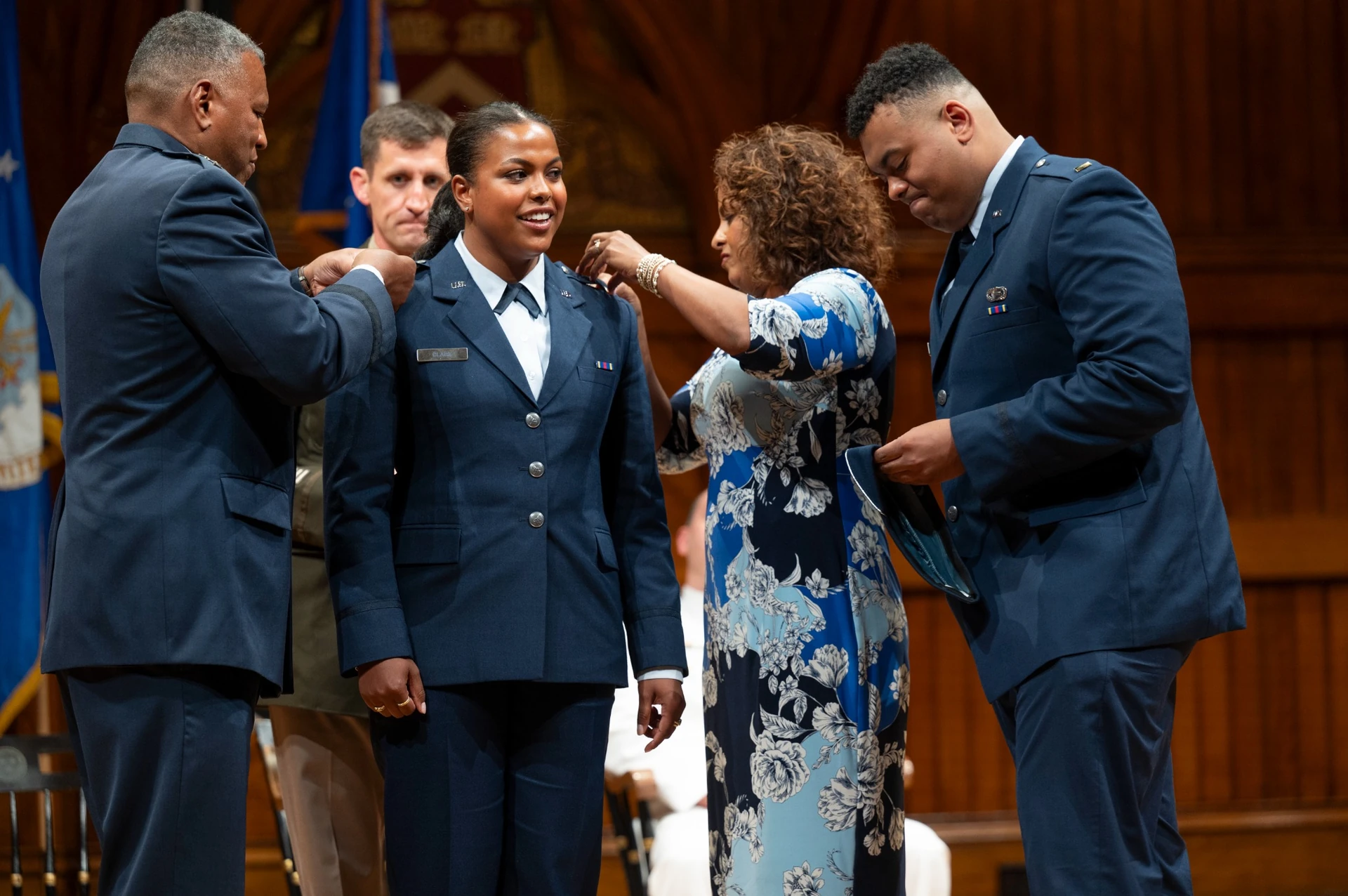
When it came time for his daughter Zoë to receive her commission and begin her own military career, he was there on the stage, too, to help pin on her stripes and hug her, along with his wife, Amy, and their son, Milo.
Members of the graduating ROTC cohort, all from the College, will enter the U.S. Army, Navy, Air Force, and Space Force.
U.S. Army:
- Lael Ayala, of Adams House, mechanical engineering, branch unassigned*
- Quin Daly, of Leverett House, economics, cyber
- Mike Greenway, of Quincy House, economics, infantry
- Sisira Holbrook, of Currier House, neuroscience, medical service corps
- Anna Keller, of Mather House, government, branch unassigned*
- Noelle Keto, of Dunster House, computer science, cyber*
- Zoe Kim, of Pforzheimer House, human evolutionary biology, medical service corps
- Jason Kwak, of Winthrop House, economics, branch unassigned*
- John Marcucci, of Quincy House, social studies, military intelligence
- Jack Martin, of Eliot House, philosophy, educational delay—JAG officer, Harvard Law School
- Max Morehead, of Kirkland House, comparative literature, infantry
- Pranav Pendri, of Quincy House, computer science and economics, cyber*
- Aidan Pesce, of Quincy House, computer science, cyber
- Eva Rankin, of Mather House, social studies, military intelligence
- Adler Schultz, of Quincy House, molecular and cellular biology, medical service corps
- Anthony Stackle, of Leverett House, human evolutionary biology, educational delay—University of Texas Southwestern Medical School
U.S. Air Force:
- Zoë Clark, of Currier House, government, contracting
- Joseph Hwang, of Lowell House, statistics, pilot trainee
- Christopher Shen, of Quincy House, statistics, operations analysis officer
U.S. Space Force:
- Michael Kuhl, of Leverett House, mechanical engineering, pursuing a master’s degree in aeronautics and astronautics at M.I.T.
U.S. Navy:
- Will Kaufmann, of Mather House, history & literature, and economics, submarines
- Thomas Leeds, of Lowell House, astrophysics and East Asian Studies, student naval aviator
- Lucas Martin, of Lowell House, applied mathematics, submarines
- Sydney Slazak, of Mather House, environmental science and engineering, oceanography
* Recognized at the ceremony, to be commissioned at a later date


