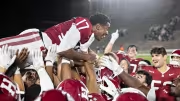
Until they reached the Yale Bowl, the Harvard football team had sailed through the 2025 season without a blemish. The Crimson entered the 141st playing of The Game with a 9-0 record and had clinched at least a share of the Ivy League title. It was their third in a row and 20th overall, outright or shared, and the second for Stephenson family coach for Harvard football Andrew Aurich in his two seasons on the Harvard sideline. If they could beat the Elis, Harvard would achieve their first perfect season since 2014.
But beginning in the first 18 seconds of playing time, that ambition was dashed. Yale not only blew away Harvard 45-28, but by doing so joined the Crimson as Ivy co-champions (see “Final Ivy League Standings,” page 19). Just as important (if not more so), the Elis nailed down the Ivies’ automatic bid to the Football Championship Subdivision (FCS) playoffs, which the league’s teams were permitted to enter in 2025 for the first time in the Ivies’ 69-year history.
For the Crimson, there was brief consolation. Harvard was rewarded for its near-season-long excellence by also being invited to the FCS tournament. Thus, they played their first postseason game since the 1920 Rose Bowl (Harvard 7, Oregon 6), venturing to Villanova. It was not worth waiting for: the Wildcats shellacked the Crimson 52-7, for a deflating ending to a largely successful campaign.
A Perfect Start
In the season’s first three games—walkover victories against Stetson and Holy Cross sandwiched around a demolition of Ivy rival Brown—Harvard did nothing to cast into doubt its status as the preseason favorite to win the Ivy title. Then, in the next five games, the Crimson went on a remarkable roll. Cornell, non-Ivy foe Merrimack, Princeton, Dartmouth, and Columbia were all dispatched in roughly the same manner. The details differed, but in each game, Harvard scored in the 30s and the opponent scored in the teens, or slightly below.
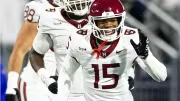
The Crimson attack was spearheaded by senior quarterback Jaden Craig, who cemented his status as one of the best (if not the best) Harvard has ever had in the position. Flinging with aplomb, Craig threw 25 touchdown passes, breaking the school’s single-season record set in 2012 by Colton Chapple ’13, and giving Craig 52 for his career, surpassing the 41 tossed by the previous Harvard record holder, Neil Rose ’03. Craig now also holds the Harvard career record for yards gained passing with 6,074, overtaking Rose’s 5,949. Further, in 2025 Craig threw only seven interceptions. At season’s end, he was a unanimous first-team All-Ivy selection.
Craig smartly distributed the ball among a capable receiving corps, with the leader being deep-threat sophomore Brady Blackburn (38 catches, five touchdowns). The ground game was a running-back-by-committee, with junior cutback specialist Xaviah Bascon (637 yards, seven touchdowns) the most dependable and prolific.
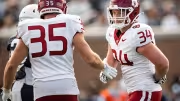
Not as flashy, the defense was reliable. Its strong point was the defensive backfield, which made passing against the Crimson a sticky proposition. The unit was keyed by senior captain Ty Bartrum. Like Craig, he is one of the best Harvard has seen. Bartrum was second on the team with 83 tackles. Another star who emerged from the defense was marauding junior linebacker Sean Line, who had 94 tackles. Bartrum and Line were chosen first-team All-Ivy, as was senior defensive lineman Alex DeGrieck, the team’s sack leader with 6.
Late-Season Woes
With the Crimson unbeaten through the first eight regular-season games, the season came down to the final two. Play by play, they were rough going.
First, Penn visited Harvard Stadium and for sustained, 60-minute offensive action, it would be hard to top the game against the Quakers. It was riveting, pulse-pounding, and exhausting. The teams combined for 962 yards in total offense and 66 first downs (33 for each). The only Harvard punt came deep in the fourth quarter. Fifteen receivers caught passes.
It was the first time all season the Crimson faced true adversity, but the team managed to recover from its setbacks. For instance: late in the second quarter, Craig engineered a last-minute, 75-yard touchdown drive that savvily employed receivers Blackburn, Bascon, senior Cam Henry, and senior tight end Ryan Osborne, plus two timeouts and a spiking of the ball to stop the clock—and ended with Craig running the ball into the end zone with five seconds left. Sophomore placekicker Kieran Corr booted the conversion. At halftime it was Penn 27, Harvard 21.
In the second half, the Crimson scored twice to take the lead before the teams commenced trading touchdowns. With 2:38 left, and the score 42-40 in favor of Harvard, the Quakers maneuvered into position for a 30-yard field goal that gave them a 43-42 lead.
Doom. Or was it? With 22 seconds remaining, Craig stayed cool and methodical, connecting with senior tight end Dean Boyd for a 21-yard gain, then spiking the ball. With 15 seconds left, he pitched to Bascon, who got out of bounds to stop the clock after gaining only one yard, then threw down the middle to freshman Ryan Tattersall for 18 yards.
The game was in the hands—or, more accurately, on the foot—of Kieran Corr. His longest previous career field goal was 38 yards. Now it was 53 yards between his swinging leg and Harvard maintaining its perfect record. The snap came and Korr’s kick sailed through the goalposts—a no-doubter. Harvard 45, Penn 43. Corr would also be chosen first-team All-Ivy.
As it turned out, the Crimson had peaked a week too early. In The Game, they were in trouble from the get-go. On Harvard’s first play from scrimmage, Craig pitched to Boyd on the left. Boyd caught the ball, but Yale defensive back Brandon Webster wrestled it from him. On the next play, Eli quarterback Dante Reno threw a 21-yard touchdown pass to Jaxton Santiago. Yale 7, Harvard 0. Eighteen seconds had elapsed.
The Elis led 17-0 before the Crimson could get on the board, on a 23-yard pass from Craig to Tattersall. Harvard again got within 10 at 24-14 on a 26-yard run by Craig. But on the last play of the half, Yale’s battering-ram back, Joshua Pitsenberger, scored on a dive play. (Pitsenberger gashed Harvard for 150 yards over the course of the game.) Continually playing from behind, the Crimson scored twice in the second half, on Craig passes to Tattersall and Blackburn. But they had dug too deep a hole.
“They came out there and they did everything that we had been doing for nine weeks,” said Aurich of his foes. “What they did, that was really impressive.” It was Harvard’s fourth consecutive loss in The Game, and seventh in the last nine Games. The most recent time the Crimson lost four straight in The Game was 1942-47 (no meetings in ’43 and ’44). Harvard now trails Yale all-time 61-72-8.
For the Crimson, it was on to Philadelphia’s Main Line for the first postseason game in more than a century. This one was no match: Villanova was just too fast and physical for Harvard. The Wildcats scored on their first series and rolled up a 31-0 first-half lead, outgaining the Crimson 336 yards to 31.
The third quarter brought a glimmer of hope when Craig flipped a six-yard touchdown pass to junior back Jordan Harris. But Villanova firmly reasserted themselves, scoring the game’s final three touchdowns. Craig had the worst day of his Harvard career, completing nine passes in 21 attempts for a mere 107 yards and tossing two interceptions. Not all the incompletions were Craig’s fault, as his receivers failed to catch throws that were on the money.
“The reality is that’s a very good offense that we just played, and they played at a really high level,” Aurich said after the game. “They played more physical than us, so that was leading to big chunks of yards in the run game and putting themselves in very manageable third downs, and that’s how you end up giving up a ton of first downs.” In that category, Villanova led 26 to 14.
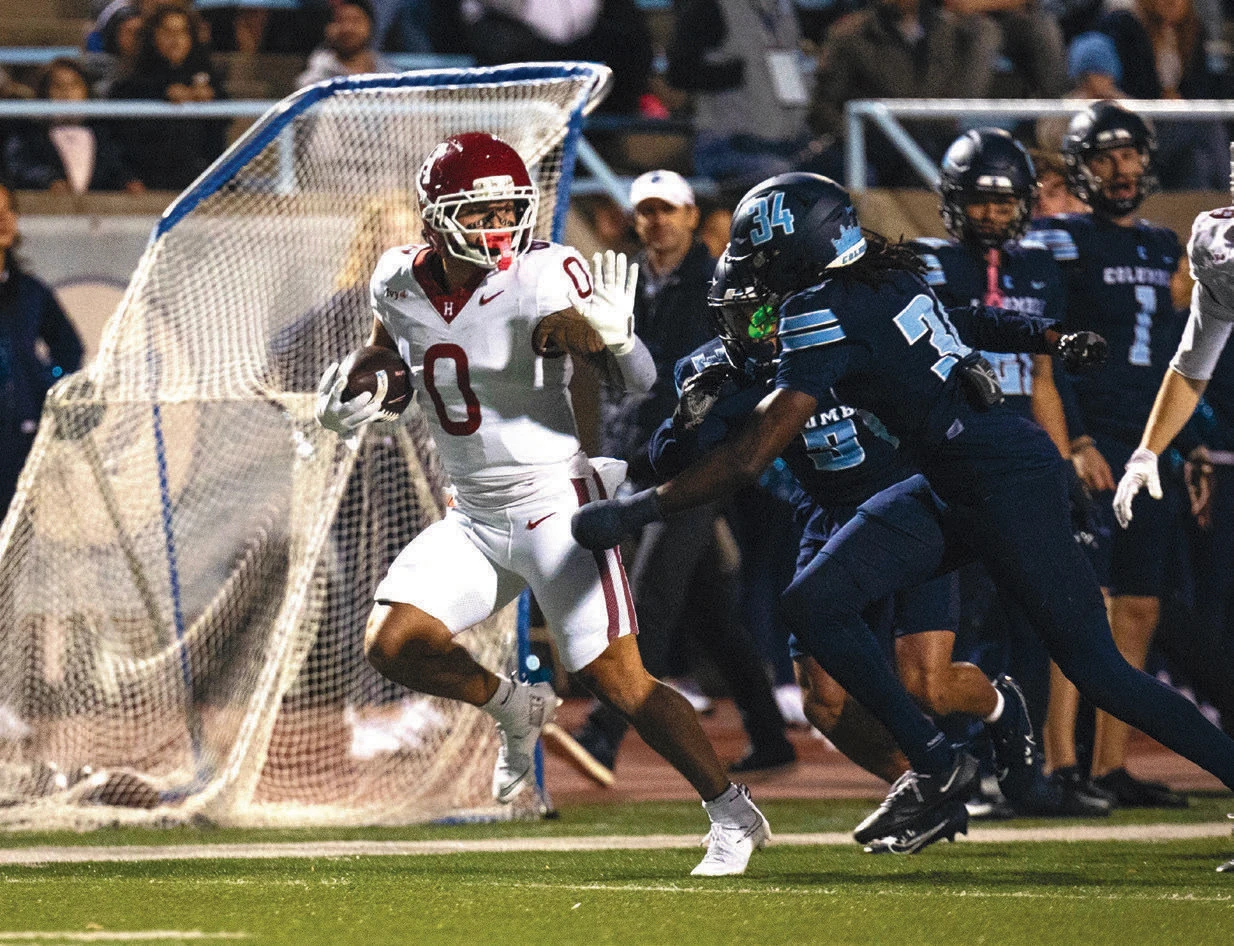
“I apologize to the rest of the league, because we did not do our part, and this will impact the Ivy League’s ability to get two teams [into the playoffs] in the future,” Aurich said.
He’s right. From here on in, to reach the postseason the Crimson will almost certainly need to win the league outright. That will be the goal when the 152nd season of Harvard football kicks off in September.
Things to look forward to: all-purpose back Bascon, a psychology concentrator from Kirkland House and alumnus of Swampscott (Mass.) High School and Phillips Exeter Academy, has been elected the 152nd captain of Harvard football.
And the 142nd playing of The Game will take place at Fenway Park on November 21, with Harvard as the home team. The Game was also played at Fenway in 2018, and the old ballyard proved friendly to the Crimson, with Harvard winning 45-27.
Here’s hoping for a repeat.