Bed furnishings in early America

A Wadsworth Atheneum and Museum exhibit reveals how we once slept.

A miniature version of a New England high-post bed (ca. 1750-1765), with historically accurate bed furnishings by Natalie Larson | Object on loan courtesy of Natalie and Bruce Larson

Photograph courtesy of the Wadsworth Atheneum Museum of Art

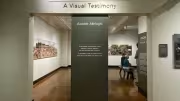
Visitors at the Wadsworth Atheneum admire a coverlet (ca. 1780)—also known as a “counterpane”—with impressive appliqué craftsmanship. | Photograph courtesy of the Wadsworth Atheneum Museum of Art

A Star of Bethlehem quilt (1842), made by Submit Gay, of Hartford. | A gift from Miss Fanny Gay Darrow. (1926.2904)

Photograph courtesy of the Wadsworth Atheneum Museum of Art

A good night’s sleep was likely hard to come by in early American homes. Privacy was rare—any beds were located in common spaces—and only householders with seniority got one; children, servants, and guests were treated to pallets, or bare floors. Rope-strung supports tightened with a wooden peg (from which the phrase “sleep tight” derives) held mattresses stuffed with horsehair, straw, wool, and moss—or, at best, with goose feathers. Curtains mitigated cold winter drafts and helped shelter sleepers (or those engaged in other, personal nighttime activities). Beds and linens were labor-intensive to produce, or extremely expensive to buy. As “Bed Furnishings in Early America: An Intimate Look”—at the Wadsworth Atheneum Museum of Art, in Hartford, Connecticut, further reveals: “Before the mid-twentieth century, a clean, comfortable bed was a luxury.”

Open through January 27, the show highlights textiles and furniture from the seventeenth to the early nineteenth centuries. An “English bed furnishing set” from 1650-1700, which was transported to America, features an enclosure made of fustian valances and curtains embroidered with crewel yarn in a flamboyant vine-and-flower pattern. A miniature, scaled version of a New England high-post bed (ca. 1750-1765) features historically accurate red-gingham bed furnishings (above) made by Natalie Larson, an expert on historic textiles and reproductions based in Williamsburg, Virginia. Other exceptional handwork, which took artisans and homemakers countless hours to complete, is also on display in bed hangings and rugs, coverlets, and quilts.

 All told, the exhibit concludes that despite the bed’s central role in reproduction, birthing, sickness, and death, holding apart “a space for comfort, warmth, and security” was largely a status symbol reflecting a homeowner’s financial standing and specific physical and emotional needs.


Read more articles by Nell Porter-Brown

You might also like

Harvard Art Museums restores a rare glimpse of an American master.

Tk tk Iran

Artist Azadeh Akhlaghi reconstructs moments of Iranian political upheaval in a series of meticulously staged images.

Science and art capture the microscopic natural world.

Most popular

Harvard’s Class of 2029 Reflects Shifts in Racial Makeup After Affirmative Action Ends

International students continue to enroll amid political uncertainty; mandatory SATs lead to a drop in applications.

The Harvard graduate’s roundtable talk show touches on hot button issues from religion to sex. 

In 1954, Gregory Corso moved into Eliot House. How he stayed there is a literary legend.

Explore More From Current Issue

Three actors perform on stage, with one actor interacting closely with another, set against abstract backgrounds.

The play Spare Parts is a contemporary fable about the quest to live forever.

Decorative wrought iron gate framed by leafy branches, captured in sepia tones.

Former Indiana University president Thomas Ehrlich looks back on curriculum, co-education, and other major trends.

Modern building with large glass windows, surrounded by greenery and pedestrians.

A roundup of University news from the summer of 2026