Toward the end of a discussion Wednesday at the Radcliffe Institute with documentary filmmaker Ken Burns and three of the Harvard historians in his recent PBS series, “The American Revolution,” the conversation suddenly turned to the present, and the fraught politics of the Trump era.
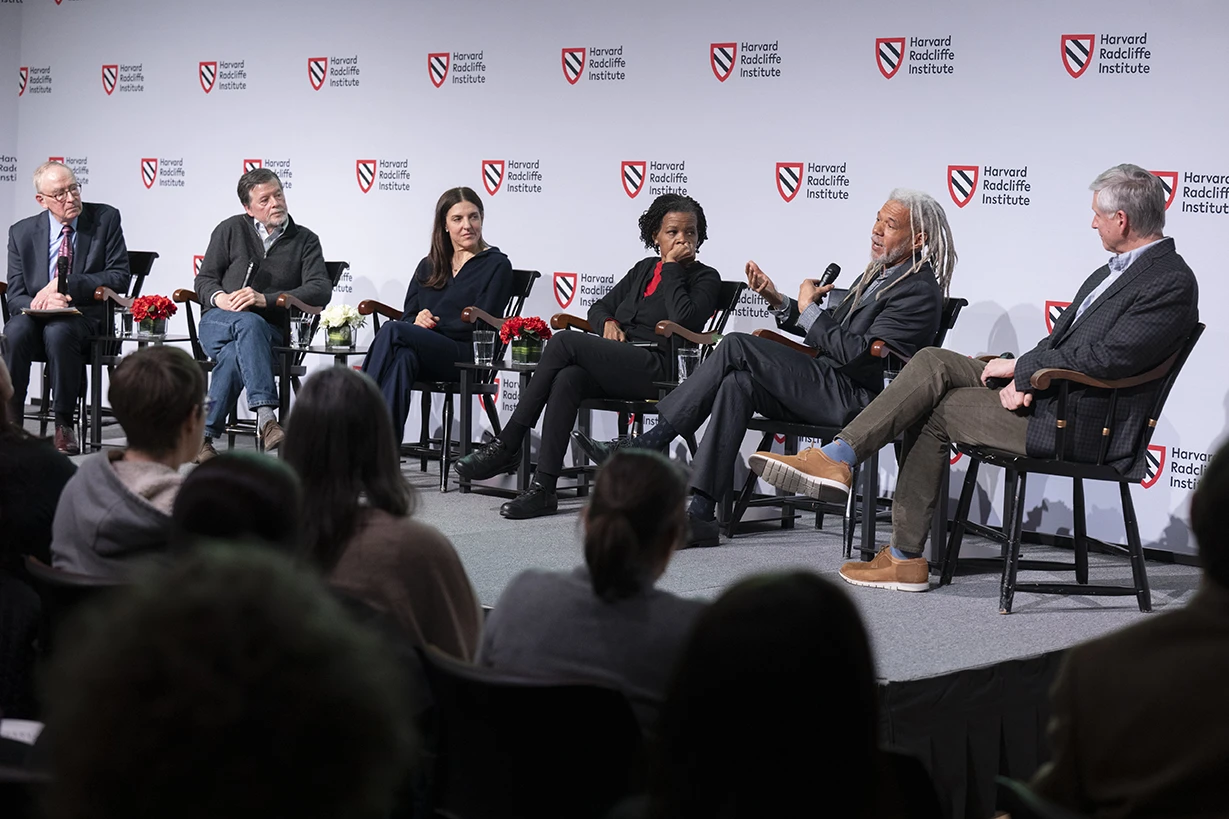
“It’s interesting that we’re having the 250th [anniversary of the Revolution] at this particular moment in the country’s history,” said Loeb University Professor Annette Gordon-Reed, speaking to a packed audience at the Knafel Center. Beside her on stage were Warren professor of history Vincent Brown and Saltonstall professor of history Philip Deloria, along with Burns and Sarah Botstein, who co-directed “The American Revolution.” Bruce Mann, the Schipper professor of law, moderated the discussion, which was co-sponsored by the Harvard history department.
“This is probably the first time that I’ve thought more about the grievances of the Declaration [of Independence] than the preamble,” continued Gordon-Reed, who is most famous for uncovering that Thomas Jefferson, the Declaration’s primary author, had fathered children with Sally Hemings, a woman he enslaved.
The grievances have long been overlooked amid the soaring rhetoric of the Declaration’s opening lines, but the bulk of the nation’s founding document consists of 27 detailed complaints against the British king. The colonists accused him of violating their rights to self-government and trial by jury, as well as levying taxes without consent and quartering soldiers in civilian homes. Several complaints detail how the king used violence and intimidation to try to force the colonists into submission.
Until recently, Gordon-Reed said, audiences at her public lectures regarded the grievances as “relegated to the past.” Now, though, amid the upheavals of the Trump administration and the president’s sweeping assertions of executive power, the colonists’ grievances spark new interest. “I go to give talks, and people want to talk about the grievances,” she said. “You start thinking about, what does tyranny mean? What are the kinds of things that these people were rebelling against? The lesson is that the experiment [in American democracy] is ongoing. ... There’s no moment that you can rest.”
Deloria, too, said his experience of the Declaration of Independence had changed. Last summer, he proposed a community reading of the document in his hometown in Michigan. “And many people said, ‘No, it’s too political,’” he recalled, to audible gasps from the audience. “I think what that tells us is … we must fight, we must continue to fight, not only for the principles of the Declaration, but for the right to speak the Declaration itself. That’s the moment we’re in.”
The unfinished nature of the Revolution and American democracy was a running theme throughout the discussion. Brown talked about how he takes seriously the universal equality and liberty promised in the Declaration of Independence, even if the men who signed it fell short in their own beliefs. A professor of African and African American studies as well as history, Brown focuses on the history of slavery—and slave revolts—in the Atlantic world, particularly the Caribbean. “The most vibrant form of nationalism,” Brown said, “is the adherence to the idea, not to any idol, not to founding fathers, not even to any document, but to the ideas expressed and articulated in those documents. Those documents are artifacts of much more important and larger ideas that we’re still fighting for.”
Burns put it another way. “It’s about possibilities,” he said. When the Declaration of Independence proclaimed that “all men are created equal,” he added, citing two historians featured in the series, Jane Kamensky and Maggie Blackhawk, “everybody knows it just means white men. But it’s deeply significant to people at the margins. … Because once you’ve said all men are created equal, the doors are opened” to countless other demands for equality—the abolition of slavery, women’s suffrage, African American civil rights, LGBTQ rights—even if it takes generations to reach them.
Alongside this, the panelists discussed the unfinished nature of how history is recorded and interpreted. Burns’s six-part documentary, which took more than five years to make, tells a much more complex and messy story than most Americans are used to hearing about the Revolution. It portrays the struggle for independence not just as a military and political triumph, but a fight to control Native American land and a brutal civil war, from which democracy arose more by accident than by intention. Incorporating the long-ignored voices of free Black and enslaved people, Native Americans, and women, the series explores the competing interests that shaped the Revolution and the profound divisions that existed, even among colonists fighting on the same side.
One of the most striking ways the documentary widened the lens of that era was by embedding much more of the Native American history that was part of the Revolution. It’s important, said Deloria, Harvard’s first full professor of Native American history, that the series identifies Boston Massacre victim Crispus Attucks as not only Black but also Native American, and that it explains the colonists’ decision to dress up as Indians during the Boston Tea Party as not simply “weird and quirky,” but as an assertion of American identity. The documentary marks the start of the war not with Lexington and Concord or the battle of Bunker Hill, but with the attacks in July 1776 on Cherokee towns in North and South Carolina and the Virginia colony’s brief war two years earlier with Shawnee and Mingo tribes near the Ohio River. “There’s a long durée story here,” Deloria said, whose “continuities become visible when we focus on the Revolution in the ways that the film does.”
The goal, Burns said, was to show enough “complicating, destabilizing” elements to shake loose the familiar but incomplete narrative of the Revolution, so that viewers “understand that you cannot fit this into a really neat box.”
That more expansive story tracks with the changes that Mann, a legal historian of the Revolutionary era, has observed in his field. When his career began in the late 1970s, he recalled, scholars of American colonial history focused only on the 13 colonies—and “truth be told, it was really only Massachusetts,” he said—but 50 years later, the field has expanded to include all of North America and the Caribbean, illuminating social and economic connections that offer a deeper and more coherent understanding of the past.
In the discussion’s final moments, Mann contrasted this expanding view of history with a more recent push to contract. A year ago this week, he noted, President Donald Trump signed an executive order titled “Restoring Truth and Sanity to American History.” It directed federal agencies to remove exhibits and signs with “improper ideologies” or depictions of the nation’s past deemed insufficiently laudatory. In museums and parks across the country, materials relating to Black history and enslavement, Native American history, climate change, and other subjects were taken down—and some have since been reinstated. “History is a tapestry of struggles,” Mann said, “for survival, for power, for wealth, for enlightenment, for knowledge, for peace. And history is also the struggle for who gets to tell it.”