1935
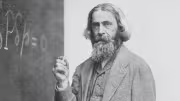
The Summer School hosts multiple discussions of national educational policy, the editors report, noting “signs that academic freedom may become a central issue in a modern struggle as momentous as the earlier struggles in this country for the principle of liberty.” They encourage “bring[ing] into schools and colleges a closer contact with the realities of life. Quacks and nostrums still succeed…despite advances in the social sciences, there is no safeguard in the general mind against the demagogue, the jingo, or the maker of false economic promises. Nor have the natural sciences routed superstition. Those who still believe that the truth has a least some part in making human beings free have much to do in seeing to it that the truth is widely known.”
1940
Harvard sets up a summer aviation camp at Plymouth, offering students a chance to earn private pilots’ certificates from the Civil Aeronautics Authority.
1955
Helen Keller ’04 becomes the first woman to receive an honorary degree from Harvard. Her fellow honorands include Andrew Wyeth, Archibald MacLeish, West Germany’s chancellor, Konrad Adenauer, and Harvard’s president emeritus, James Bryant Conant.
1960
The Faculty of Arts and Sciences establishes a new degree, A.B. in Extension Studies, to replace the Adj.A. (adjunct in arts) previously awarded.
1970
The Faculty of Arts and Sciences resoundingly votes down the so-called Princeton Plan already adopted by 15 other universities: a proposal for a two-week recess during the fall so students may participate in political campaigns.
1990
Widener Library will require stack users to sign in “after an unidentified vandal mutilated more than a hundred books and a phone message threatened physical harm to anyone who interfered.”
2010
The Medical School updates its conflict-of-interest policies, prohibiting faculty participation in industry-sponsored speakers’ bureaus and limiting industry funding for continuing medical-education course content.