Manhattan might have the longest-standing Jewish congregation in the country, but Newport, Rhode Island, claims the oldest synagogue. Dedicated in 1763, Touro Synagogue served a thriving colonial Sephardic Jewish community, and stands today as a testament to principles of religious tolerance in America. The historic building and adjacent Loeb Visitors Center are open year-round, and attract visitors from across the globe, notes docent Lew Keen. During a recent tour, he said historians believe that around 1658, 15 Jewish families sailed from Barbados into Newport harbor. Having heard that earlier Jewish settlers in New Amsterdam had been ill-treated, the new arrivals chose instead a colony of multiple faiths led by those who, like Rhode Island founder Roger Williams, insisted on the separation of church and state. “That was revolutionary in its time,” Keen reminded visitors. “So, the families found life was good here. So good, that in 1677 the community had the money to purchase land, up the hill from the Old Quarter, that is now the oldest existing Jewish burial ground in the country.”
Photograph courtesy of the Touro Synagogue
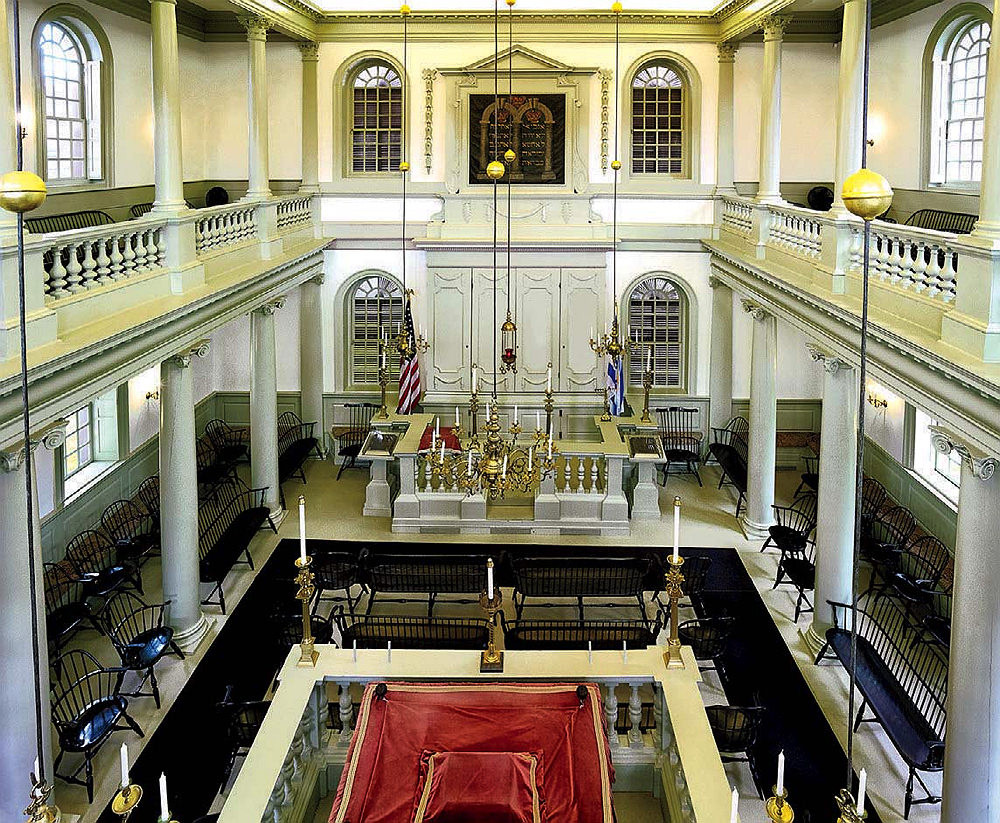
Newport was then a small outpost, but, because of its deep, sheltered harbor, it would soon grow into one of the wealthiest port cities, rivaling Philadelphia, Boston, and New York. By 1759, the congregation Nephuse Israel was planning to build a synagogue and hire its first spiritual leader. “They wanted a rabbi from Europe, but none of them would come here,” Keen noted, “so they got an 18-year-old student by the name of Isaac Touro.” He led construction of the building, which was designed by America’s first architect Peter Harrison, a fascinating figure who brought Palladianism to New England and is credited with some 450 buildings, across many continents, including Christ Church, in Cambridge, and Kings Chapel, in Boston. Constructed of red bricks from England (now painted over), the synagogue holds 12 original columns—solid tree trunks—along with a clock, candelabras, and charity boxes dating to the 1760s, and still offers services. Praying congregants—historically the men were downstairs and the women in the balcony—face the ark, oriented toward Jerusalem. The Newport Jews, of Spanish and Portuguese origin, from families who fled the Spanish Inquisition, and found refuge in Amsterdam, and then the Caribbean islands. Unlike other New England colonial communities anchored by a single Christian church on a common green, in Newport’s Old Quarter the synagogue is within a cluster of other houses of worship—for Quakers, Baptists, and Anglicans, among others—thus reflecting some degree of peaceful integration. “Everything wasn’t perfect,” Keen allowed, “but, generally, everyone got along.” (For a fuller picture of Jewish life and colonial Newport, also take the walking tour of the Old Quarter and explore the Loeb Visitor Center’s edifying exhibits.)