How many pyramids can one man excavate in a lifetime? Hundreds, it turns out, in addition to temples, tombs, settlements, and fortresses along the Nile. One of Harvard’s first and most accomplished archaeologists, George Reisner, A.B. 1889, Ph.D. 1893, Litt.D. 1939, came to Harvard from his native Indianapolis. By the end of his career, he had dug 23 archaeological sites in Egypt and Sudan, revealing intricate gold jewelry, colossal statues, unique historical hieroglyphic inscriptions, carved and painted tomb chapel walls, and the countless everyday objects of the ancient Egyptians and Nubians (Sudanese).
Focusing originally solely on the languages and cultures of the ancient Near East, Reisner earned his doctorate under the country’s first Assyriologist, David Gordon Lyon, then Hollis professor of divinity. It was only subsequent postdoctoral work in Berlin that exposed him to the world’s foremost Egyptologists. A single year of teaching back at Harvard was followed by an offer to join an international commission in Cairo to publish the collections in the Egyptian Museum. Reisner and his wife Mary set off, ostensibly for a single year—that stretched into 40 more. In Egypt, philanthropist Phoebe Apperson Hearst offered him an entirely new career path: to learn archaeology “on the job” for the University of California, Berkeley, and her new museum in San Francisco.
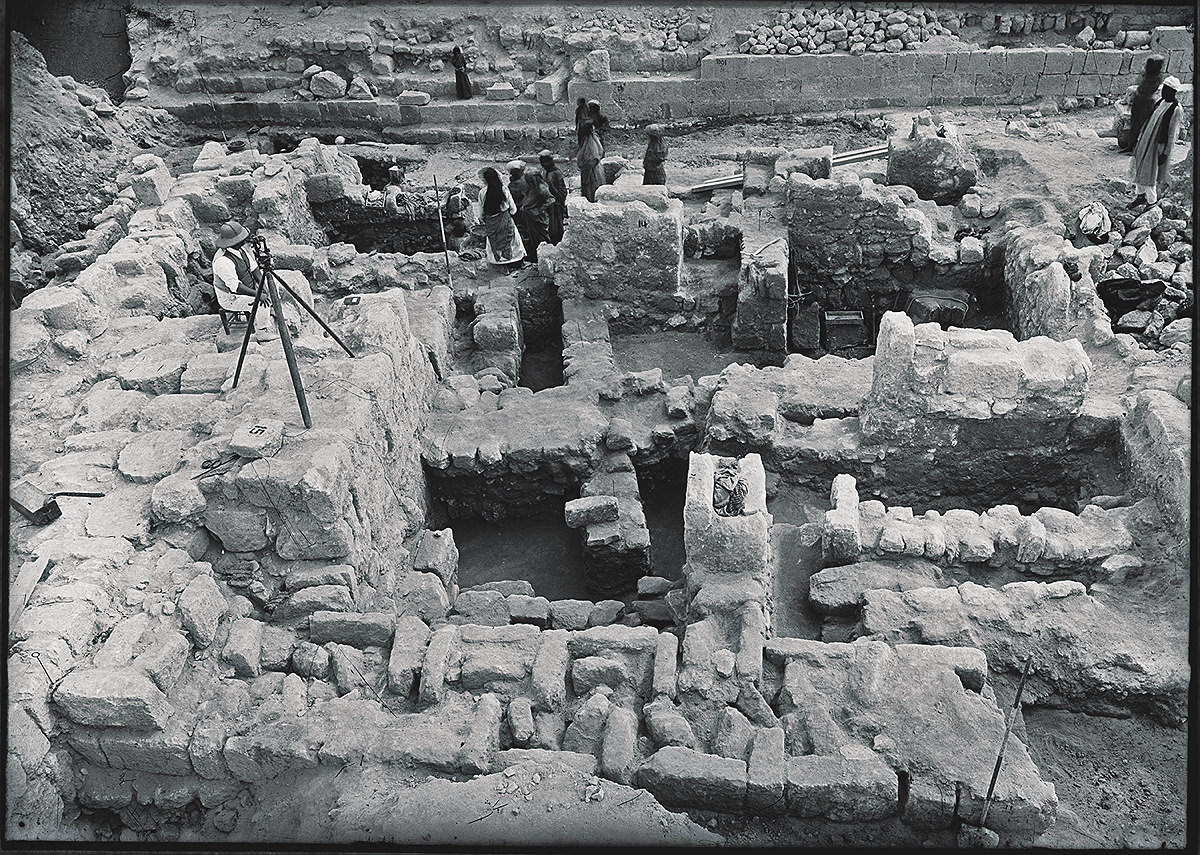
Reisner-led excavation at Samaria, 1909-1910
Photograph courtesy of Peter Der Manuelian
Reisner revolutionized archaeological method with rigorous deductive reasoning and meticulous documentation. His teams kept “dig diaries” and register books, took 45,000 glass-plate photo negatives, and produced thousands of archaeological drawings. Honing his new craft first at sites in Middle Egypt, he jumped at the opportunity in 1903 to excavate the cemeteries surrounding the famous Giza Pyramids, just west of Cairo. He eventually cleared two-thirds of the site, including in 1925 the mysterious tomb of Queen Hetepheres (mother of Khufu, a builder of the Great Pyramid), 90 feet underground. When Hearst had to pull her funding in 1905, Reisner navigated the often treacherous politics on both sides of the Charles River to create the Harvard University-Boston Museum of Fine Arts Expedition. Reisner was passionate about archaeology as a tool for historical research. His only hobby? Reading detective novels—he bequeathed his 2,000 volumes to Widener Library, and they shipped home from the Giza Pyramids after his death. His family accompanied him on every dig, and his daughter Mary’s first exposure to a floor not made of dirt came only several years after her birth.
Reisner’s discoveries multiplied during the tumultuous decades of British political control, French Antiquities Service control, and the Egyptians’ yearning for independence. There were tens of thousands of finds, including magnificent royal statues of King Menkaure at Giza, and even a solution to the mystery of the great Sphinx. But funding was always tight up at the “Harvard Camp” dig house behind the Pyramids, so Reisner gladly accepted the Egyptian government’s offer to survey cemeteries of ancient Nubia (modern Sudan) south of the First Cataract (or rapids), an area soon to be flooded due to the raising of the Aswan dam. This work opened his eyes to new archaeological frontiers, so from 1913 onward he explored the powerful Nubian kingdom of Kerma, and then the temples and pyramids by the holy mountain of Gebel Barkal, where he was the first to discover the hidden entrances to Nubian royal pyramid complexes. Additional royal Nubian cemeteries followed (Nuri, el-Kurru, Meroe), then he explored the many elaborate mud brick Egyptian fortresses built to guard the southern border.
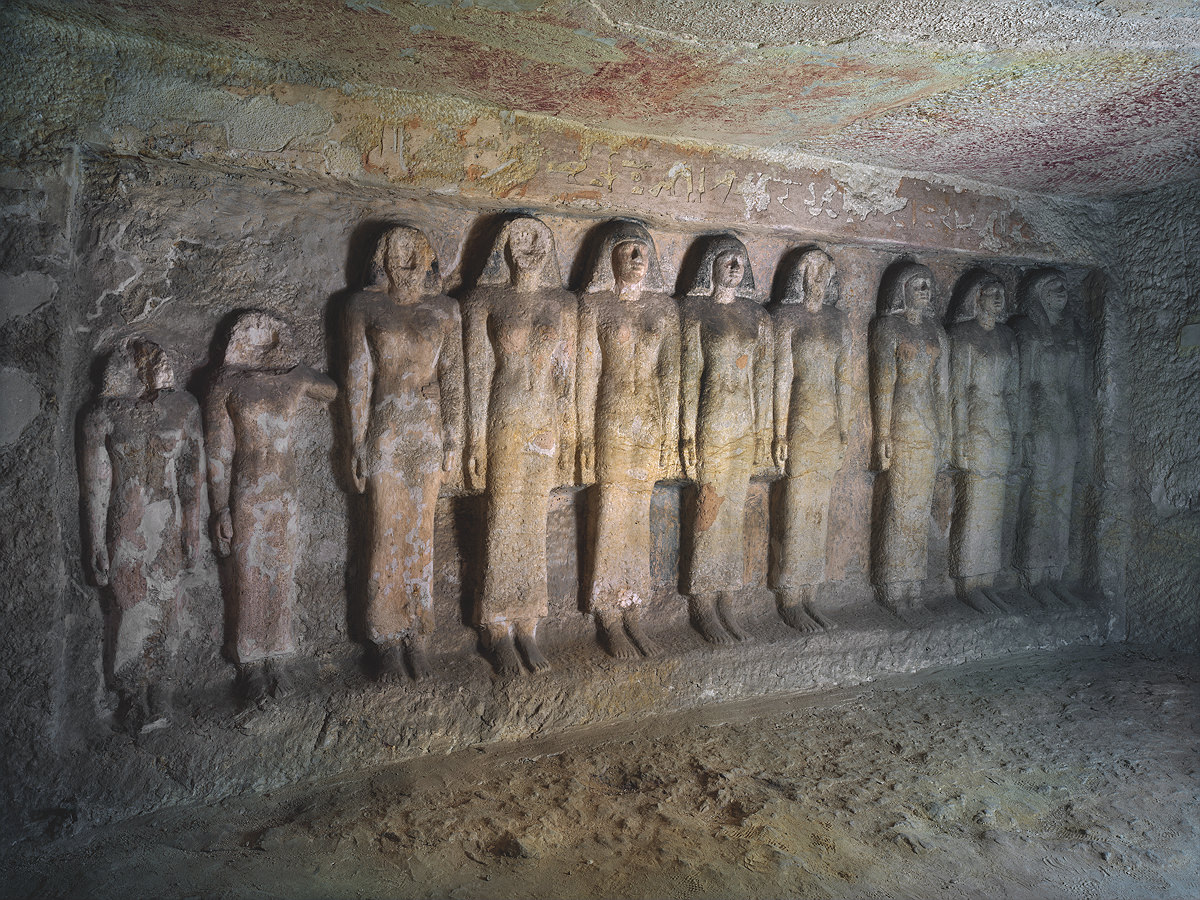
The chapel of Queen Meresankh III, Fourth Dynasty, at Giza; Reisner discovered the tomb on April 23, 1927.
Photograph by Bridgeman Art Library
The 50/50 division of finds in those days resulted in crates of antiquities bound for the Cairo Museum, Khartoum, the Museum of Fine Arts, Boston, and Harvard’s Peabody Museum. Reisner became professor of Egyptology at Harvard and curator of the MFA’s Egyptian Department. But he rarely returned to Boston, even excavating right through World War I when all the other foreign missions shut down. The only blemish on this remarkable career was Reisner’s at times colonialist attitude. Although ahead of his time in championing the cause of his Egyptian workmen, he supported British control of the country. Worse, he could never quite embrace the existence of a great African civilization in the Sudan, supposing the ancient Nubians to be displaced Libyans or Egyptians instead. In these racist misinterpretations he was hardly alone, but his carefully compiled scientific record allows us to easily set aside those theories that are no longer tenable today.
After a final trip home for an honorary degree at Harvard’s 1939 Commencement, Reisner died, blind and bedridden, at the Giza Pyramids in 1942, as Rommel’s divisions threatened the Pyramids from the west. Reisner’s greatest contributions remain his Pyramid Age work at Giza (see https://giza.fas.harvard.edu) and his documentation of the cultures of the ancient Sudan. It is a tribute to his career that almost all his archaeological sites that are still accessible are under investigation today by new generations of archaeologists, armed with research questions made possible only by the solid foundations he laid.