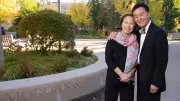
Five-time Grammy Award winner and professor of practice in the Music Department, esperanza spalding (who does not capitalize her name) will depart the University. In an email to department affiliates last week obtained by Harvard Magazine, the bassist, singer, composer, and opera librettist said she is leaving Harvard because, “Sadly, what I aspire to cultivate and activate in organized learning spaces is not (yet) aligned with Harvard’s priorities.”
“For many months I’ve been in conversation with the Dean’s office, hoping that we could devise, guide, or break-open a way for me (and other professors with similar priorities) to remain in relationship and co-learnership” with Harvard students and faculty, she wrote. Her departure comes after multiple conversations with University officials about implementing her “Black Artist-Educators Decolonizing and Placemaking (BAEDAP)” model, which she envisioned as either a course or initiative.
BAEDAP “works to devolve portions of colonial institutions’ holdings, and through doing so, help heal their impact-on, and relationships to, communities of color.” Under the BAEDAP model, Harvard would “rematriate” some of its land and buildings, offering them as spaces where “Black and Native artists, scholars, students, activists, and cultural workers,” as well as the broader Harvard and surrounding community, could collaborate and make art.
She attached the BAEDAP proposal to her departure email, which outlined that the initiative would use pre-existing campus buildings, with all money earmarked for BAEDAP going toward artists’ site-specific creative work and community programming. She noted that the model is “one approach to devising curricular pathways that might help institutions (and artist-faculty) move beyond metaphorical commitments to decolonial education, Black and Native solidarity (respectively), and reparations.”
“To remain in relationship to Harvard, I must be directly engaged in generative and reparative interventions to restructure and remediate the historical and lingering colonial impacts of this institution,” she wrote. Yet, she says it became clear “there wasn’t a path forward for a BAEDAP-like practice at Harvard.”
Dean of arts and humanities Robin Kelsey could not comment on the specifics of spalding’s contract negotiation, but said, “Professor of the practice positions are designed to enable us to bring world-class artists and performers to Harvard, and these world-class artists and performers have broad ambitions for their work in the world. Sometimes we can find a way to make those ambitions align with Harvard and its mission in a given moment, and other times, it’s more difficult.”
For spalding, BAEDAP represents a way to contend with Harvard’s history. “I am no longer willing to endorse a cultural norm whereby artists & artist-educators passively participate-in, and benefit-from institutions born and bolstered through the justification, and/or ongoing practice of exploiting and destroying Black and Native life,” she wrote in her proposal. “Countless gifts have been delivered to humanity through this University, yet they cast a long shadow in light of Harvard’s origin, political history, and economic foundation inextricably linked to Black and Native subjugation.”
Kelsey reiterated that spalding will be greatly missed. “She is an incandescent artist who inspired our students and taught our communities in ways I will never forget,” he said. “If we have ambitions to bring in people with national and international practices, and broad ambitions for artistic practice and performance in the world, it’s not always going to be easy for us to find ways to dovetail what we do day-to-day at Harvard with those ambitions, as a general matter.”
“I hope in some ways that our community is willing to take risks with artists that may at times yield a shorter stint than we are accustomed to with our tenured faculty,” Kelsey said. Speaking of spalding, he said, she “has dreams of things to do in the world, and I can’t wait to see what she does. Whenever those dreams line up with possibilities here at Harvard, I will embrace the chance.”
Following her departure from Harvard, spalding plans to devote more time to the BAEDAP-like space she’s been developing for artists of color on a plot of land in Portland, Oregon's St. Johns neighborhood.
At Harvard, spalding was known for developing close mentorships with her students and holding extracurricular jam sessions where students (musicians and otherwise) could experiment with spontaneous musical expression. She reiterated in her email that she would miss her Harvard students and welcome them in Portland any time. “These past 5 years have been so fun, so generative, so challenging, so full of new sounds and stories, new friends,” she wrote in her email. “I’m gonna miss y’all!”