How did Democrats lose the support of Silicon Valley—and can they get it back?
This was the question that Van Jones, CNN host and political analyst, explored with McCormark professor of citizenship and self-government Archon Fung at an April 21 fireside chat hosted by the Ash Center for Democratic Governance and Innovation and co-sponsored by the Harvard Kennedy School’s Institute of Politics.
In the early 2010s, Silicon Valley and the political left in the U.S. were close-knit, drawn together by geography and a narrative of shared liberal ideals, said Jones, who served in the Obama administration. “It didn’t feel like a marriage of convenience,” he said. “It felt like the future had arrived.”
Rooted in California’s liberal political culture, Silicon Valley positioned itself as a counterweight to Wall Street. In the wake of the 2008 financial crisis, tech leaders were seen as builders—innovators generating economic and cultural value rather than extracting it from society. “The idea was that Wall Street is cheating,” Jones said. “They’re ripping everybody off. These kids in Silicon Valley are actually making things—and that’s the right way to get rich. The wrong way is Wall Street.”
At the same time, the industry’s growing influence began to draw new scrutiny. As Jones recalled, “As you move through the Obama years, you start to enter a period when the growing power of technology is being taken more seriously, especially by people pushing for greater inclusion.”
Even then, the cultural dynamics that some would later label “tech bro culture” were already present, though less explicitly defined. Jones described an environment shaped by what he called “sins of omission”: an industry that emerged from a relatively narrow demographic base that was predominantly white and male, with a smaller presence of Asian workers.
According to Jones, one of the most striking aspects of the tech industry’s growing conservatism is how quickly it developed. Silicon Valley remained firmly opposed to U.S. President Donald Trump as recently as 2020, he said. Tech billionaire Elon Musk expressed support for Andrew Yang during the 2020 Democratic primaries. And after the January 6, 2021, attack on the U.S. Capitol, the tech sector acted decisively. “Silicon Valley deplatformed Trump,” Jones said, “and they threw him off Facebook.”
By the start of Trump’s second term as president, however, several influential figures in Silicon Valley—including OpenAI CEO Sam Altman and Meta CEO Mark Zuckerberg—had distanced themselves from the Democratic Party. At the same time, other high-profile tech CEOs and investors, including Elon Musk, Peter Thiel, and Marc Andreessen, had become outspoken supporters of Trump and the broader MAGA movement. The explanation, Jones and Fung argued, lay in a convergence of pressures during the Biden presidency.
First, there was a shift in regulatory posture. Fung suggested that unlike the more collaborative approaches of earlier Democratic administrations, Biden’s presidency was marked by more confrontational regulation, including efforts led by former Federal Trade Commission chair Lina Khan. Jones characterized the shift as “pure antagonism.” Policies, especially around emerging sectors such as cryptocurrency, were perceived as inconsistent and punitive, amounting to what critics described as “regulation by enforcement.”
Second, internal workplace dynamics intensified. Tech executives faced rising employee activism on issues such as equity and ethics, while also encountering increasing hostility from Washington. In Jones’s framing, the industry was caught between a “bottom-up woke movement” and a “top-down regulatory motion.” Fung noted that similar tensions are reemerging today, citing resistance within companies like Anthropic and Google, where employees expressed concern about their technologies being deployed for mass surveillance or used to develop autonomous weapons.
Third, deeper ideological currents began to surface. Libertarian skepticism of government had long existed within Silicon Valley, Jones suggested, but had remained contained. Over time, “that little virus,” as he described it, began to grow. Finally, as companies matured, their incentives shifted. Jones called tech leaders “monopolists” who want to innovate without friction, acquire potential rivals early, and build closed ecosystems that keep the market concentrated.
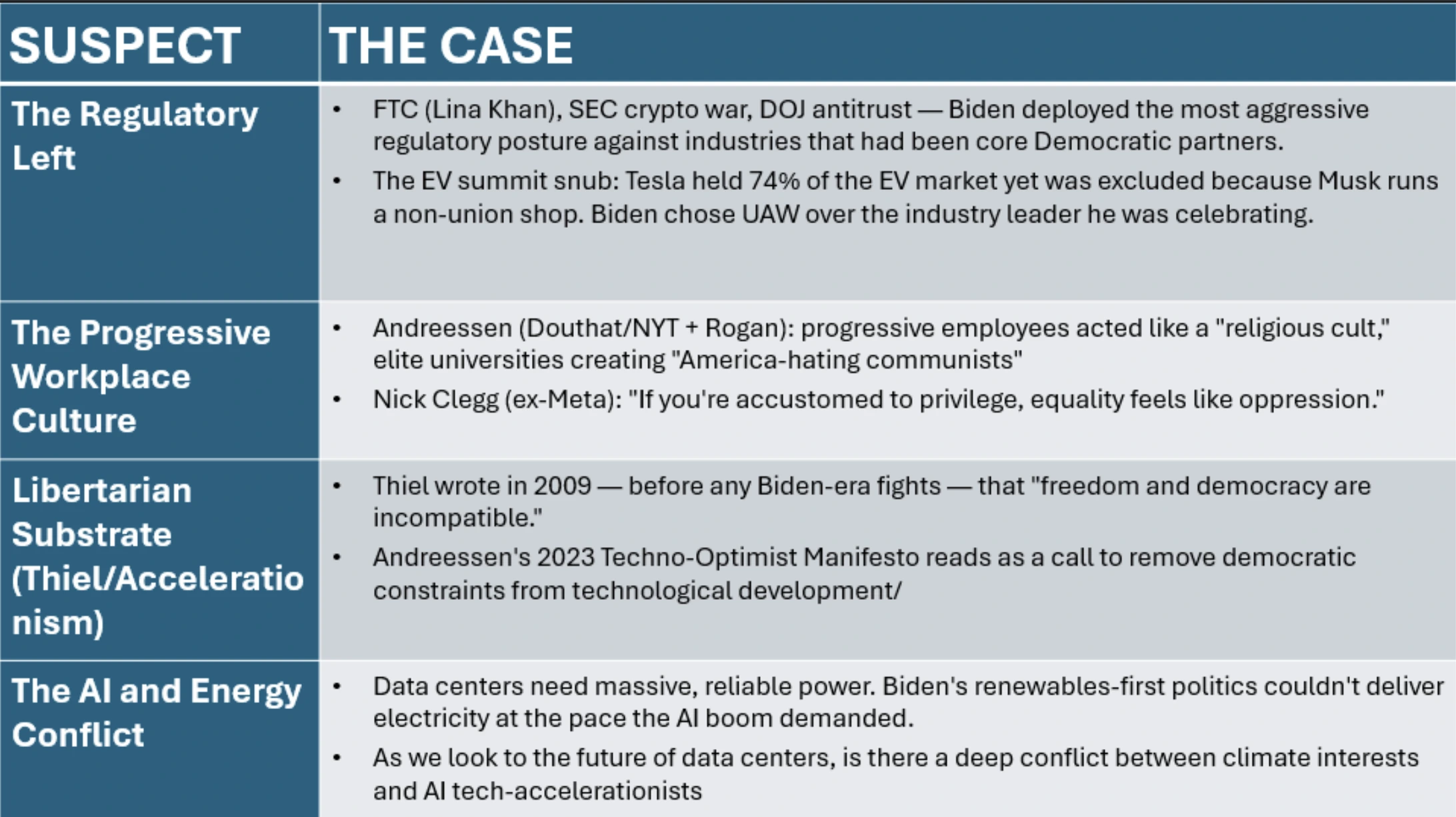
Jones also criticized what he described as a shift toward moralized conflict on both sides, in which “everything [became] a fight,” with both tech companies and the political left believing they were advancing the broader public good. He extended this critique to contemporary progressivism, arguing that it has become more adept at identifying problems than building solutions.
Jones also warned that emerging technologies, especially artificial intelligence, are poised to reshape the economy. To navigate those changes, Jones called for a return to coalition-building that would allow Democrats to maintain their progressive values but operationalize them more effectively. He pointed to the need for a “new deal” between technologists and society that could work to distribute the gains of innovation more broadly. The guiding question, he said, is: how do we ensure that technological abundance does not concentrate in a few hands and benefits the many?