
Daniel Fisher likes to ask difficult questions and, although he is a theoretical physicist, his latest inquiries have led him to tackle problems in modern biology. For example: How does one make sense of the vast amount of data that the life sciences now generate? Modern physicists, as it happens, are unafraid of mountains of apparently random information because they have tools for finding patterns, for querying the chaos. Recently, the professor of physics and applied physics has been working with Markus Meister, professor of molecular and cellular biology, to develop frameworks for understanding how the human eye processes visual information, distinguishing, say, between a capital letter E and a capital B on an eye chart. "The random movement of your eye is on a scale as large as a blackboard," says Fisher, while the difference between the two letters is minute. How do our neurons deal with or perhaps make use of the eye's jitters? he wants to know. Fisher has advanced models to try to understand this and other problems, such as how the brain performs complex tasks almost as quickly as simple ones. Research has shown that "there is not enough genetic information to wire the whole brain," he explains, so if it is wired by a somewhat random process, what kind of random wiring would be needed for it to operate as fast as it does? Fisher's models of "small world networks," which propose that any one neuron is separated from any other by a small number of steps think six degrees of separation in the brain have been consistent with experimental data. But "Processing this parallel?" he marvels. "No one, I think, has the faintest idea of how the brain does this."
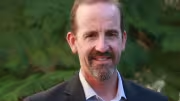
Daniel S. Fisher
Daniel Fisher likes to ask difficult questions and, although he is a theoretical physicist, his latest inquiries have led him to tackle problems...


Explore More From Current Issue

A rare Egyptian mummy case is on display at the Harvard Museum of the Ancient Near East.

The University is expanding industry ties and investing its own funds to support research, but neither will replace lost federal dollars.

For advocacy and benevolence, three late alumni are reportedly in line for the Catholic Church’s highest honor.