In an historic vote, the Faculty of Arts and Sciences (FAS) moved to make the articles that its members publish in scholarly journals freely available to anyone, “disseminating the fruits of its research and scholarship as widely as possible.” The action acknowledged that the intellectual wealth of the world increasingly lies at our fingertips.
The Internet has made this possible, but there is a disturbing countertrend: even as some kinds of information become more readily available (public-domain books in Harvard’s libraries, for instance, through collaborations with such projects as Google Books), other kinds of information are becoming more difficult to obtain. In particular, scholarly articles conveying the latest breakthroughs in technology, science, and medicine—the kind of information those afflicted with a rare disease might wish to access, and, as taxpayers, might even have funded—are locked up in expensive journals (an institutional subscription to Brain Research, to cite an extreme example, is more than $22,000 a year), or are otherwise not easily accessible.
The motion considered at the FAS meeting on February 12 at first seemed a minor sortie into copyright law. A “yes” vote would grant the University a non-exclusive, nonprofit license to faculty members’ scholarly articles, and require them to deposit a copy in an “open access” repository. But the motion, which passed unanimously, was, in fact, an important milestone in a much larger “open access” movement that aims to make all scientific and scholarly material, particularly articles published in peer-reviewed journals, freely available over the Internet. “The goal of university research is the creation, dissemination, and preservation of knowledge,” said University provost Steven E. Hyman in a public statement. “At Harvard, where so much of our research is of global significance, we have an essential responsibility to distribute the fruits of our scholarship as widely as possible.”
Open access (OA) is generally achieved in two ways, through OA archives or OA publishing. The latter, in which articles are peer-reviewed and vetted as usual but distributed freely over the Internet, has had some success: of the roughly 20,000 scholarly journals published today, about 3,000 are OA.
Harvard’s new policy takes the archiving approach, by creating a searchable on-line repository. “Faculty members still retain copyright to scholarly articles they write, but any transfer of copyright they make to a publisher will be subject to the nonexclusive license to Harvard, which will retain its right to distribute the article freely and openly,” explains Welch professor of computer science Stuart Shieber, chair of the provost’s committee on scholarly publishing that drafted and presented the new policy. Professors can make the articles available to students in class, and readers worldwide can download copies.

Photograph by Stu Rosner
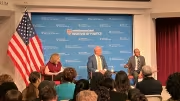
Stuart Shieber
Peter Suber, principal drafter of the first major international statement on OA, the Budapest Open Access Initiative of 2001, has described Harvard’s new policy as the first university mandate for open access by default in the United States, and the first to be adopted by a faculty, rather than implemented by administrative fiat. Harvard’s policy is a “default,” rather than a true mandate, because it includes an opt-out provision, or waiver—for instance, if the paper of a junior faculty member is accepted at a major journal that doesn’t allow OA archiving. Either way, compliance is expected to be much higher at Harvard than at institutions where OA archiving is optional, and where participation rates rarely exceed 15 percent, Suber says. His research also indicates that articles available through OA enjoy increased visibility, retrievability, usage, and citation impact—and aren’t incompatible with for-profit publishing.
Just a month before FAS acted, the National Institutes of Health (NIH) announced that it would become the first major research funder with an OA mandate. Its previous voluntary policy led to participation rates that hovered “between 4 and 7 percent,” explains Alexa McCray, deputy director of Harvard Medical School’s Countway Library. (Because the NIH doesn’t make grants to individuals except through their institutions, the institutions will be responsible for tracking authors’ compliance with the new policy.) That policy requires that publicly funded papers be placed in PubMedCentral, an OA repository of full-text articles, says McCray. She adds that pending legislation would require all federal funding agencies with grant budgets in excess of $100 million to adopt a policy similar to NIH’s—making the Harvard move seem prescient indeed.
The director of MIT’s library, Anne Wolpert, calls the FAS open-access policy “bold and visionary”—a collective action that “allows Harvard to support its faculty.” Under the current system of scholarly publishing, she says, faculty members’ intellectual content is “freely donated to private ownership.”