New Harvard entrepreneurship center

Harvard's three-legged encouragement of entrepreneurship

Photograph by Susan Young Photography

Photograph by Susan Young Photography

The University’s encouragement of entrepreneurial endeavors now is three-legged: on November 3, the student-focused Harvard Innovation Lab (2011) and alumni-oriented Harvard Launch Lab (2014) were joined along Western Avenue by the 15,000-square-foot Pagliuca Harvard Life Lab, complete with 36 wet-lab benches and 50 “coworking desk spaces” to incubate life-sciences and biotechnology start-ups. Initial users include 17 ventures, from Akouos (hearing loss) through  XGenomes (gene sequencing), each typically consisting of two to five people. Benches rent for $2,500 per month, and a private lab suite for a fledgling resident team is $15,000 to $18,000 monthly. 

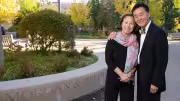
Harvard hopes that the innovation centers, Business School, and engineering and applied sciences complex (scheduled to come on line in 2020) will have a synergistic effect—and will, over time, help to populate the planned  “enterprise research campus” envisioned for Allston, much as MIT and the adjacent, booming Kendall Square have become the center for biotech and pharmaceutical companies. To that end, the new lab facility began life auspiciously: it bears the name of donors Judy Pagliuca, M.B.A. ’83, and Stephen Pagliuca, M.B.A. ’82, co-chair of Bain Capital, the $75-billion private-investment firm. And just before Thanksgiving, Bain filed to solicit funds for a life-sciences investment pool.
Read more articles by John S. Rosenberg

You might also like

At informational town hall meetings, faculty and staff press administrators for details.

The Emmy-winning journalist was a mainstay of political coverage at NBC for two decades.

He was Harvard’s quintessential people person.

Most popular

The former economics concentrator brings his talent for crunching numbers to netminding.

Naval architect William Francis Gibbs, designer of the SS United States

Brief life of America’s greatest naval architect: 1886-1967

Human origins driven by technological and cultural revolutions

Ofer Bar-Yosef argues that cultural and technological revolutions have been more important than biological ones during the past 100, 000 years.

Explore More From Current Issue

Label showing the anatomy of a worker bee, featuring a detailed illustration.

Science and art capture the microscopic natural world.

Singer performing on stage with a guitar, wearing a hat, and surrounded by band instruments.

Singer Elisa Smith’s whiskey-soaked voice and subversive feminism is part of the genre’s urban shift.

Racing driver gives a thumbs up from inside a car, wearing a helmet and safety gear.

Harvard graduate and NASCAR racer Patrick Staropoli on pedals, attention, and fearlessness.