London’s Chelsea Theatre can be found off a main road in the Royal Borough of Kensington and Chelsea, a neighborhood where household incomes are typically three times the national average. By contrast, the theater itself is tucked into the World’s End Estate, a public-housing complex built in the 1970s that also includes a school and a church. The irony of affordable housing hidden away in an area rife with cafés bearing names like “Juice Baby” and antique shops selling £35,000 chandeliers is lost on no one; this is the borough where, in 2017, 72 people in the Grenfell Tower council flats lost their lives to a preventable fire and became the face of inequality caused by the British government’s austerity program.
The 30-year-old theater has just completed an 18-month, £2.5-million capital campaign refurbishment and now faces a new challenge. It seeks to reposition itself as a venue presenting work comparable to that of the prestigious Royal Court Theatre (just down the road in townhouse-lined Sloane Square), while remaining affordable and welcoming to the more than 2,500 residents in its backyard.
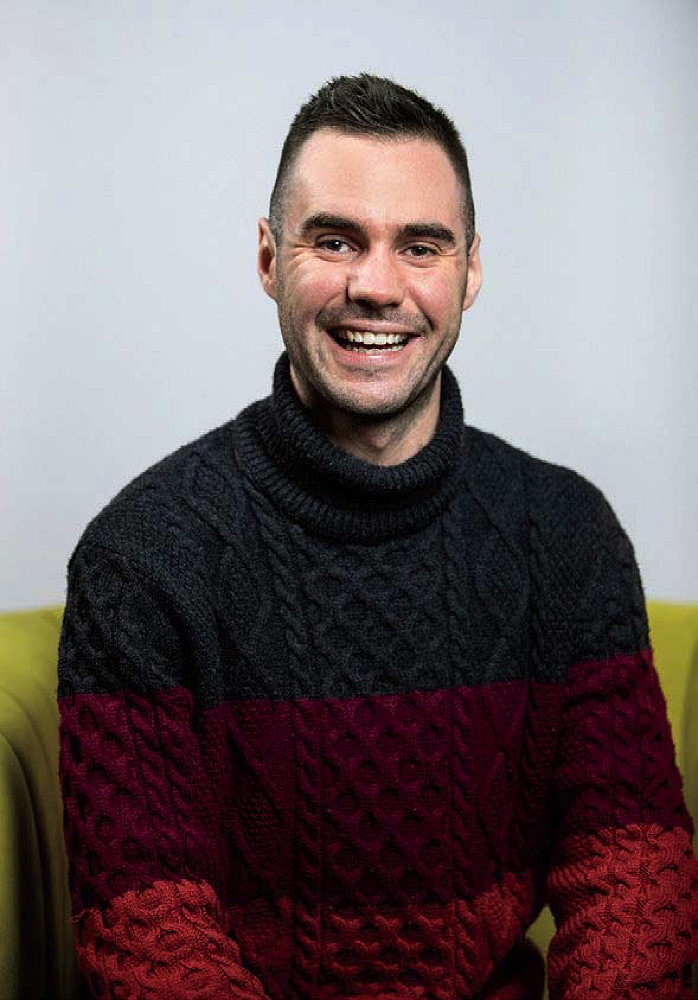
Joshua McTaggart
Courtesy of Joshua McTaggart
In 2018, Joshua McTaggart ’13 was recruited to lead the Chelsea into its second life as its joint artistic director and CEO. At the time, McTaggart was the founding artistic director of another London theater, The Bunker, which he and a business partner had converted from an abandoned parking garage into a thriving off-West End locale. (Ironically, The Bunker lost its lease in 2019, a victim of the ever-shifting ecologies of London’s arts and real-estate industries, and is set to close this spring, just as the Chelsea prepares for its eventual opening.)
McTaggart discovered a love of theater, and directing in particular, at Harvard, thanks to campus extracurriculars. (He graduated before Theater, Dance, and Media became a concentration.) His most memorable shows included a 25-person production of Stephen Sondheim’s Sweeney Todd in Farkas Hall, and British writer Mark Ravenhill’s Pool (no Water), performed, fittingly, in the Adams Pool Theatre, a repurposed swimming pool with no water. These undergraduate productions represented a valuable time and environment in which artistic risks were not only possible but encouraged, he says, with support from the Harvard-Radcliffe Dramatic Club and the Office of the Arts.
After graduating from Harvard with a concentration in history and a secondary field in English, McTaggart plunged into London’s “fringe” theater scene, directing plays on shoestring budgets in rooms above pubs and managing theater festivals. Then came The Bunker. There, he says, “being an artistic director meant making sure the toilets got cleaned as well as picking plays.” He cares just as much about the lavatories at the Chelsea, but also has the additional role of CEO, providing financial guidance and strategy for what he deems a “civic space” rather than either a community center or theater. In the redesigned Chelsea—a modern, open building with high ceilings and natural light—studios are used for community projects like film clubs for women over 50 and pop-up offices for local housing associations. Programming for the fully flexible, 135-seat theater was set to start this fall, but will be delayed several months because of the coronavirus pandemic.
McTaggart intends for the Chelsea to engage actively with the political reality of being a cultural institution on a public-housing estate. What ties together the CEO and artistic director strands, he says, is the importance of ethos: “Part of my job is asking, ‘Where are we heading in the next five years?’ What do we stand for, what risks are we willing to take? What money are we willing, or not willing, to take from certain groups?’”
Central to his conception of artistic direction is being clear about exactly for whom and what purpose the space and program are designed. In its 1990s heyday, the Chelsea was renowned for new work. Experimental playwriting sensation Sarah Kane previewed Crave there in 1998, David Tennant and Tamsin Greig performed on its stage, and Anthony Hopkins was a patron. McTaggart is eager to revive the Chelsea’s commitment to exciting work, albeit content that is more intimately connected to its original intended audience: the residents of World’s End.
He is primarily concerned with projecting a novel but welcoming image, designed to engage as much as entertain. “It’s about cultivating an environment where we are able to take a risk with work that is challenging and difficult, but also relevant and reflective of where we are here and now.” The theater’s first season will commission professional writers to “engage with local residents to develop a trilogy of new plays about issues, challenges, ideas, and stories that come from local conversations,” McTaggart explains. The trilogy will run in repertory, supporting a youth-apprentice program designed to introduce local students from 16 to 25 to careers in theater production, including lighting and sound design, production management, and direction.
As the 28-year-old McTaggart prepares to open his second theater venue in four years, he recalls that when he co-founded The Bunker, critics complained that London didn’t need a new theater. He says he recognizes the unease outsiders felt about two 24-year-olds founding a theater in a parking garage, but he stands by the risk, even if there had been no reward. If anything, his convictions today are even stauncher as he looks ahead to his work at the Chelsea. “If it’s easy to just start a company and become an AD, and there’s no investment in what that means and what the ethos is, then you shouldn’t do it,” he declares. “If you don’t feel like you’re putting yourself out there and taking risk, then is it really worthwhile?”