As classes begin for one of the most challenging semesters in Harvard and higher-education history—with most instruction remote, only a small cohort of undergraduates in residence, and rigorous coronavirus testing and other measures to protect the health of students, staff, and faculty members present—President Lawrence S. Bacow this morning disseminated an opening-days message to the community, with the subject line, “Veritas.”
“I have thought a lot over the past few weeks about what words of welcome I might offer you as we begin an academic year in an age of upheaval,” he began. “What can one write at a moment such as this?”
He then turned to some of the challenges:
When Adele and I were sick with COVID, you shared with us not only welcome words of comfort but also bracing accounts of your own struggles with the pandemic. After George Floyd was killed and in the midst of stunning protests, you told powerful and personal stories about the experience of being Black in America. You called on Harvard to fight racism and denounce white supremacy—important work that has only grown in urgency since the shooting of Jacob Blake. You also sought justice for international students not just from Harvard but from colleges and universities across the country, and you found joy—and relief—in the University’s victory over an unlawful directive. All the while, you were trying to make sense of everything as you navigated life as teachers and learners, co-workers and colleagues, and parents and caregivers.
Throughout his career, Bacow has emphasized the values that knit an academic community together, the privileges and responsibilities associated with membership in such a community, and the social capital that accrues when members acknowledge the contributions they make on one another’s behalf. Under the current circumstances, those themes emerge anew, with fresh relevance, in this morning’s missive:
I think our isolation has helped us to see one another more clearly and completely, and to appreciate our community in new ways. We each long to return to a normal life, one that allows us to share time with friends and family, and to greet new acquaintances without fear. I wish I knew how much longer we will be living under this cloud, but I do know that I am cheered by the willingness of everyone at Harvard to do what is necessary to sustain our important work of teaching, scholarship, and service. To our faculty and staff who have worked so tirelessly and selflessly to prepare for the start of this academic year, thank you. To our scholars who have dedicated themselves to understanding, diagnosing, treating, and preventing this disease and everything that it has wrought, thank you—we are all in your debt. To our students who have met extraordinary challenges with a unique combination of grit, determination, and good cheer, thank you. And, finally, to the families and loved ones who have demonstrated tremendous patience and understanding in the most unusual and trying of circumstances, thank you. Thank you all for hanging in there.
During his remarks in yesterday’s virtual College class of 2024 Convocation (streamed on YouTube), Bacow even more explicitly addressed the pandemic and the logistics of trying to control it, the national upheaval over racial injustice, and the importance of both taking up hard political and other disagreements and doing so in a generous, tolerant, self-reflective spirit. His message this morning echoed that theme, in the context of operating, necessarily, at a remove from one another:
Now, we begin a semester unlike any other. What we do will be important, but how we do it will matter even more. When we get it right, we will celebrate. When we get it wrong, we will commiserate—and try again. The truth is that none of us knows what lies ahead, but we face this uncertainty together. I look forward to the day when we have all of this in our rearview mirror so I can see you again in person. Until that day comes, please take care of yourselves, your families, and each other.
With that, the students and scholars were invited to begin their work together. To Bacow, his senior management colleagues, and the deans are reserved the continuing hard tasks of figuring out how to pay for operating during the pandemic now, contend with the continuing (and huge) decrease in Harvard revenues, and sustain the research and teaching enterprise in the years to come. A year of upheaval indeed.
[The following section added September 2, 2020, at 1:40 p.m.]
“In Praise of New Rituals”
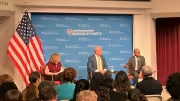
President Bacow also offered a Morning Prayers address, typically delivered in Memorial Church on the first morning of classes each academic year. This year’s version was disseminated online. It began with a half-amused, half-rueful, “So, how did you spend your summer vacation?” After proceeding to explain how his summer ritual of relaxing, away from the office, on a boat with his wife, Adele, was disrupted, President Bacow addressed the larger disruptions imposed by the pandemic, and proposed new rituals for the community during this new, uncharted academic year:
Even outside of faith traditions, we mark and measure the passage of time in ritual. In birth and in birthdays, we welcome and celebrate life. In marriage, we recognize and encourage commitment. In death, we remember, we gather, and we grieve—together.
The thing that I found most disquieting about this pandemic is that it has stolen from us so much ritual—even the simplest act of a morning walk into Harvard Yard—for me, into Massachusetts Hall—greeting familiar friends and colleagues is no more. These things that anchored us in countless ways have been swept away. We are unmoored, adrift, and—in far too many cases, I fear—alone.
It’s tempting to despair—tempting to relinquish hope and to turn inward. But things that sometimes take from us also give us something in return. And as we enter the uncharted waters of a semester unlike any that any of us have ever encountered before, I offer a morning prayer in praise of new rituals.
Waking at home instead of on campus—working at home instead of on campus—these are actually commitments to keeping members of our community safer than they would otherwise be. They are our new ritual.
Wearing a mask—enduring a testing regimen—these are daily celebrations of life—yours and the ones that you will save by being cautious and vigilant. Also a ritual.
Offering kindness—practicing patience and understanding—these are meditations on humanity. Who are we? What are we doing here? How are we helping—how are we serving—one another?
May every moment of this most unusual year be a moment for finding new ways—for discovering grace in unexpected places and for renewing our faith in one another by creating new ritual.
Together, I’m confident we will weather this storm until we reach familiar ports once again—stronger and better for all we have endured—filled, I hope, with gratitude. Thank you.
The president’s remarks can be viewed in full on YouTube. The text appears here.