1918
The Harvard Club of North China contacts President Lowell, offering a prize of $100 to the student “who writes the best paper on any subject connected with China.” The 64 Chinese students on campus far outnumber those from any other country: Canada is second with 25, and Japan, with 21, is third.
1928
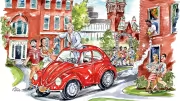
The Parietal Committee, facing changing conditions and new problems caused by an increasingly urban environment, forbids Harvard undergraduates to live in apartment houses.
1928
The Harvard Club of Philadelphia has presented the Harvard Band with what is claimed to be the largest drum in the world. The instrument debuted on the last day of the Associated Harvard Clubs meeting in Philadelphia.
1933
Harvard defeated Princeton, 79 1/3 to 55 2/3 points, in the track and field meet in the Stadium on May 6—the first time the distances in the various events were measured by the metric system.
1938
Noting that Harvard has apparently become the first institution of higher learning to enter into a contract with a national labor union, the Alumni Bulletin reports that nine employees’ units have participated in perhaps the first official election to determine the bargaining agent between a university and its employees. Five groups (among them dining hall and kitchen workers) chose the American Federation of Labor, four groups (maids and maintenance men) chose the Harvard Employees’ Representative Association.
1963
The Corporation terminates the appointments of clinical psychologists Richard Alpert and Timothy Leary for involving undergraduates in drug research and for unauthorized absences during term time.
1968
Coretta Scott King speaks at Class Day in her late husband’s place. On Commencement afternoon, demonstrators denounce the main speaker, the shah of Iran.
1978
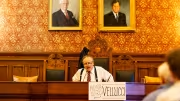
Social Sciences 2, “Western Thought and Institutions,” the “last surviving example of General Education as Harvard first offered it,” comes to an end as Eaton professor of the science of government Samuel H. Beer shifts to half-time teaching.
1998
The Crimson celebrates its 125th anniversary, capping off a year that includes inauguration of free delivery to all undergraduates, launching a financial-aid program, and a change from a six- to a five-day-per-week publication.