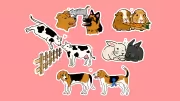
Petunia
I was moved by “The Love Bunnies” (July-August 2026, page 23) especially because it treated Petunia’s story as something more than a sweet animal anecdote. The article made a thoughtful connection between companionship, grief, and health, but what stayed with me most was the quieter question of responsibility.
A domestic rabbit does not choose the shape of her own life. People choose her space, her food, her safety, her medical care, and even the conditions under which she might meet a new companion. Petunia’s need for another rabbit was real, but so was her dependence on patient human care. Petunia could not be rushed into a new bond. She had to be watched closely, respected, and allowed to move at her own pace.
For me, the story was not only about loneliness, but about care. The animals who live with us are not accessories to our emotional lives. They are lives entrusted to us, with needs that may look small from the outside, but are not small in moral weight.
José Laércio de Araújo Filho
It was touching to see a love story about Petunia the rabbit. Readers were reminded that rabbits are not simple or interchangeable creatures, but individuals with rich emotional, social, and cognitive lives.
The issue highlights a striking disconnect. While one rabbit’s story inspires empathy, millions of rabbits suffer in industries that produce Angora wool, test cosmetics, and supply laboratories. The same issue of Harvard Magazine includes discussion of research on captive octopuses—extraordinary, complex animals capable of experiencing pain, fear, distress, and joy. Their intelligence and solitary nature make confinement for experimentation especially troubling.
In my field, primate studies have been defended as essential to HIV vaccine development, yet despite hundreds of vaccines that appeared safe and effective in chimpanzees and monkeys, none translated to humans. Most drugs that pass animal tests fail in human trials. Meanwhile, human-based approaches—organ-on-a-chip technology, cell culture, computational and AI methods—are delivering. If readers can recognize themselves in one rabbit’s story, perhaps they can also ask what we owe the millions of equally sentient animals whose lives remain unseen.
Lynn E. Taylor ’88
A quote at the end of your sweet feature, “The Love Bunnies,” got me thinking about the layers of (mis)understanding about widowhood that I’ve observed in contemporary American culture, especially since The Widows’ Handbook poetry anthology was published in 2014. My own experiences lead me to agree with Stephanie Cacioppo: “It’s not time that heals grief, but other people.” Family, friends, neighbors, support groups, counselors, even sympathetic strangers encountered by chance, can contribute the sustenance we need. Petunia is fortunate to have found another rabbit with whom she can live, among people who care how she feels as a rabbit instead of reducing her to a collection of lab data or applying sentimental anthropomorphism.
What Cacioppo’s quote leaves out is what time actually does to pain. Time makes our pain less acute, searing, and shocking. For many years, memories merely turned a knife in the wound. They were gaping holes in the fabric of my life. Only now, 21-plus years later, can I recall what my late lamented brought to my life without weeping. Most widows don’t “move on”—we go forward as best we can, one shaky step at a time.
Jacqueline Lapidus, M.T.S. ’92
Dark Skies
As co-chairs of the American Astronomical Society’s Committee on Astronomy and Public Policy, we were pleased to read Matt Crossman’s article on efforts to preserve our planet’s dark skies (“Head Toward the Darkness,” July-August 2026, p. 36). The aggregate effects of light pollution are impacting all but the most remote professional observatories, including those in which Harvard is a partner. However, we would also like to highlight a growing threat to dark skies not mentioned in the article: reflected sunlight from an expanding number of large satellite “constellations” in low Earth orbit. Every transient streak of reflected sunlight recorded in an astronomical image makes it harder to identify legitimate signals (e.g., from hazardous inbound asteroids). In some cases, the reflected light is the satellites’ purpose.
A telling example is [clean energy] start-up Reflect Orbital’s plan to launch 50,000 orbiting mirrors to reflect sunlight onto the nighttime side of Earth. The FCC’s recent approval of Reflect Orbital’s application to launch its first satellite, which deemed its “deployment of a solar reflector...beyond the scope of the Commission’s authority to regulate,” exemplifies how the current inability of any U.S. government authority to consider the terrestrial impacts of satellite constellations has become a threat to dark skies in its own right.
Andrew Baker ’94 and Richard Green ’71
If we are going to reduce light pollution, we must reduce fear of the dark. One could say that this is a life-changing process. When I was 10—I’m now 92—I was afraid of ghosts, so I ventured out in the dark of night to confront them. This exhilarating experience rid me of fear for a lifetime. I have climbed the Matterhorn, flown 52 different types of aircraft, and operated on thousands of people. I can still begin to fear, but I can always control it. Please confront your fear. You will find it is not nearly as fearful as it at first seems.
George C. Denniston, M.P.H. ’61
Harvey Mansfield
I don’t know what possessed Professor Harvey Mansfield (“Harvard According to Harvey,” July-August 2026, page 12) to claim that feminism “generally denies sex differences.” In rebuttal, I will cite someone who perhaps knew a bit more about feminism than Professor Mansfield. The late Justice Ruth Bader Ginsburg had this to say in her 1996 majority Supreme Court opinion that declared unconstitutional the Virginia Military Institute’s refusal to admit female cadets: “Inherent differences between men and women, we have come to appreciate, remain cause for celebration, but not for denigration of the members of either sex or for artificial constraints on an individual’s opportunity.”
Linda Greenhouse ’68
It’s always fun to see a profile of a feisty, quotable old Harvardian like Harvey Mansfield. But he undercuts his championship of rationality and his crusade against “leftist” doctrine with his own doctrinaire edicts. No, Professor, feminists do not deny sexual differences. No, Professor, liberals are not dismayed by the idea of “human greatness.” (Here we have the familiar sneering conceit that only Republicans can appreciate Shakespeare.)
Professor Mansfield has lived long enough to see the triumph, in Trump, of ultra conservatism—which gives us censorship of history, defunding of science, and boxing matches on the White House lawn. Is this what he wanted? Personally, I must admit, I miss liberalism.
George Timson ’67
Human Evolution
Our genes are still learning new tricks (“Humans Haven’t Stopped Evolving,” July-August 2026, page 20). But genes alone are not driving our evolution. As professor of evolutionary biology Joseph Henrich wrote in The Secret of Our Success, cultural evolution has been the central force driving human genetic evolution for hundreds of thousands of years. One of our earliest cultural adaptations was learning to use fire, perhaps as long as a million years ago. In his book Catching Fire, Richard W. Wrangham, Moore professor of biological anthropology emeritus, cited the importance of cooked food in human development, especially the evolution of our brains.
Just as fire enabled the evolution of our archaic ancestors, so too is electricity enabling the evolution of modern humans. Since learning to control electricity, we can use intelligence which resides outside the brain. We can interact with one another remotely. We can live in space and see Earth rise from beyond the Moon. Electricity is displacing fire as the foundation of our existence. A new species of human is arising in the Electric Age.
Steven Reed Nelson, LL.B. ’65, M.P.A. ’66
Speak Up, Please
Harvard Magazine welcomes letters on its contents. Please write to “Letters,” Harvard Magazine, 7 Ware Street, Cambridge 02138, or send comments by email to yourturn@harvard.edu. Letters may be edited for length, clarity, or content.
Emilee Hackney
Thanks to Nina Pasquini and Nell Porter Brown for their article about Emilee Hackney (“Writing Home,” July-August 2026, p. 50). So many of us have experienced leaving home and attending college with the expectation of people and experiences that will shape us and help us discover ourselves. Hackney’s memoir will certainly add to our furthering how we view ourselves and the diversity we bring to that attempt.
Rich Lewine ’69
Private Equity
In the “News in Brief” section of the July-August edition, there is notice of N.P. Narvekar’s leaving as manager of Harvard's endowment. In this one paragraph, there are not one but two mentions of “private equity:” first, that he increased Harvard's private equity holdings, and second, that the new appointee to the endowment’s board is CEO of a private equity firm.
Despite howls of protest from private equity owners themselves, most Harvardians know that the sole purpose of private equity is to make money. In my field of health care, that purpose is blatantly harmful. Buying hospitals, clinics, and nursing homes and running them to make money simply results in less clinical staff, less time per patient, and consequently and obviously, a decreased quality of care. Harvard should not be proud that its money is being earned in this way.
Richard S. Winslow, Jr. ’64
The Pump
In the College Pump (“Assertive Architecture,” July-August 2026, p. 59), writing on famous architects who designed buildings at Harvard, Primus did not mention Walter Gropius, who led the design team for the Harvard Graduate Center that is now used as a dormitory complex for the Law School. These buildings have withstood the test of time and are a prime example of Bauhaus architecture in the U.S.
David Handelman, J.D. ’62
In “Assertive Architecture,” two apparently forgotten commissions could have been mentioned. One was Allston Burr Lecture Hall, designed by Jean Paul Carlhian and opened in 1952. It was awarded the Harleston Parker Medal in 1953 but was knocked down in 1982 in favor of Sir James Stirling’s Sackler Museum, with its monumental entrance of rather dystopian aspect.
The other was Hunt Hall, designed in 1895 by Richard Morris Hunt as the original Fogg Museum and later used by the Graduate School of Design. It had an exterior of Indiana limestone and a collection of plaster casts of the Parthenon frieze lining the lobby. In spite of strong voices raised in its defense, it succumbed to the ruthless determination of University authorities and was demolished in 1973. A cheap new dormitory was quickly shoehorned onto the site.
Samuel R. Blair, M. Arch. ’63
With all due respect to the architectural profession and its traditions and preferences (my background before law school was in physics), my warmest feelings from an architecture perspective are reserved for the old Law School buildings—in particular, Austin Hall, Langdell Hall and Gannett House—and the older buildings in the Yard. Peabody Terrace strikes me as nondescript. The Science Center, considered very modern in the 1970s, served my purposes as a short-cut, and there was at least one building (which I will not name) that I considered so plain and ugly that when I walked past it I reminded myself to try to choose another route the next time.
Robert Kantowitz, J.D. ’79
Grade Inflation
Grade inflation is a problem that has infected American education across the board for a very long time (“The Last A’s You’ll Ever Need,” March-April 2026, page 24). My own experience with it dates back 20-plus years when I had the desire to “pay back” and teach at a private college following my retirement. I came under increasing pressure to “grade on the curve” and it soon became clear that for the price of admission, the majority of my students expected an A on the course final. After one semester I had my own insight into the system of private education. As an adjunct, I had the luxury of independence that my mortgage-paying colleagues did not have, and I was free to walk away from it.
Robin Petty, M.B.A. ’70
Have things really gotten so bad that faculty and students must submit themselves to an arbitrary cap on the percentage of A grades? Can’t Harvard faculty design rigorous courses with clear learning objectives and assess student performance objectively?
As an engineering professor at a major research university, I am surprised and dismayed. For my nearly 40 years as a professor, average performance has been assigned a B in my undergraduate lecture classes, as it has matched achievement of basic learning objectives. An A-range grade has required demonstration of a learned ability to apply key concepts in important ways that were not covered in detail in lecture and homework. Importantly, my students have understood what must be learned to earn an A.
Harold G. Monbouquette ’79
Your report on the Faculty of Arts and Sciences vote to cap A grades in undergraduate courses frames grade compression as a problem of standards. I think it is really a problem of measurement, and AI has quietly broken most of our instruments.
This past semester I taught a supply chain analytics course where students could freely use AI on every assessment, including exams. Instead of banning the tool, I redesigned the target. Assignments were open-ended problems with real data, evaluated out-of-sample, and grading was relative to the performance of the class.
The results were reassuring. If AI truly replaces thinking, all scores should converge, and the only variation should come from randomness in the data. This was not the case. Students did substantially better than an AI baseline, differences between students persisted across assessments, and the patterns were consistent with sustained engagement rather than outsourced thinking. When the goalpost moves proportionally with the tools, differentiation returns on its own. No cap required.
A grade cap treats the symptom, which is too many indistinguishable A grades. Relative evaluation on problems that AI cannot trivially solve treats the cause. The cap and AI-era course design converge on the same principle: grades are informative when they are earned under fair competition. The second path just produces more learning along the way.
Elioth Sanabria
Errata
In the profile of Katie O’Dair (July-August 2026, p. 58), the text misstated the work George Washington did while at Wadsworth House; he convened the first Council of War and received guests including Abigail Adams and James Warren.