Sacred and secular, the University's observance of September 11 proved both a moving memorial to the thousands who lost their lives to terrorists, and a reassuring reminder of the ordinary routines and responsibilities of daily life.
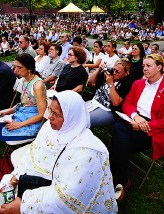
The service itself was extraordinary. Several thousand people gathered in Tercentenary Theatre at noon, in breezy but temperate weather, under a shifting sky of gray and blue. Those nearest the terrace in front of Memorial Church sat on the lawn, but most in the audience stood during the 40-minute program, or sat on the Widener Library steps. Unlike a Commencement crowd, or the celebratory audience for Nelson Mandela's appearance four Septembers earlier, this one was utterly quiet, called to order by the tolling of the church bell, the blowing of the shofar, the chanting of the adhan and of the Bodhicaryavatara. (The program for the ceremony noted that the bell, donated by President Abbott Lawrence Lowell to honor Harvard's World War I dead, is inscribed, "In memory of voices that are hushed.")
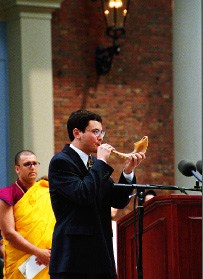 | 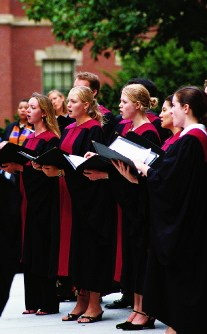 |
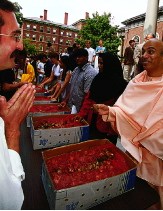
| Scenes from a memorial service: Jonathan Esensten '03 (above) blows the shofar as L. Priyadarshi Shukla, Div. '03, looks on; the Choral Fellows of the University Choir perform a commemorative work (right); Swami Tyagananda, president of the United Ministry at Harvard, helps distribute daffodil bulbs (bottom). | |
 |  |
| Photographs by Jim Harrison | |
The welcomes and invocations were ecumenical, too, beginning with remarks by Swami Tyagananda, president of Harvard's United Ministry. He recalled that selfless acts by those who responded to the terrorist attacks "brought out the best in human nature, and that filled us with courage and strength." Leaders of Hillel, the Islamic Society, and the Zoroastrian Association at Harvard echoed his wish that on this date every year people could observe a day of "remembrance and hope." Then students read from the texts of seven sacred traditions, beginning with the Koran and concluding with the Jewish memorial prayer, El-Maley. After the fourth reading, choral fellows of the University choir sang "Canticle: Mosaic in Remembrance and Hope," composed for the occasion by Carson P. Cooman '04.
Recalling the shock and grief he helped address exactly one year earlier in the same venue, President Lawrence H. Summers said, "We vowed then that we would remember and we have." In current perspective, he said, "we cannot evade the truth that what we commemorate here today is more than just the tragedy of human lives lost.... It is the result of a calculated plan to murder unsuspecting people...because they were members of this national community enjoying the fruits of freedom." Confronting "the eternal existence of evil," he said, "we regard the world with understanding and openness, but we must also face it with moral clarity. We may debate the nature of truth, but there are truths beyond debate. Pursuit of that truth is our particular objective." Those "privileged to be part of a great university," he said, must "use our knowledge to build a world of deeper understanding, greater justice, and heightened respect for human life. For centuries, Harvard has been proud to serve the American nation; and now, increasingly, we are called to serve the world as well." That service he defined as "pursuit of truthour high and common purpose."
The bell resumed its somber tolling, the assembly rose for the benediction by Peter J. Gomes, Pusey minister in the Memorial Church, and the observance ended. Those who wished to took daffodil bulbs, donated by a local nursery, to plant in memorial gardens around campus.
Unscripted were the abundant signs of everyday activity during the ceremony. Jets climbed overhead on routine flights from Logan Airport, where only military craft flew a year before. Patrons exited and entered Widener, free to pursue their individual interests. A professor strode toward the Faculty Club. Late-summer insects buzzed in the trees. A bus proceeded down Quincy Street, and motorists honked through Harvard Square. High above the Yard, one of the local red-tailed hawks surveyed the silent crowd on a deliberate, circling transit, west to east. On September 11, 2001, the very idea of normalcy had seemed shattered.