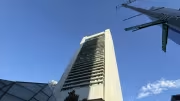
Spring beckons, and with it, images of archetypal Neo-Georgian brick enclosing quads of trig lawn, crisscrossed by asphalted walks and dotted with stately trees: think the River Houses and Harvard Business School (HBS). But in his wanderings, Primus has encountered a radically new design vernacular for University landscapes of the twenty-first century and beyond. Fittingly enough, it anchors the science and engineering complex (SEC) across Western Avenue from HBS, now home to the applied scientists who are engineering that future (see “A Transformation in Allston,” page 11).
Along the street, the SEC looms over a conventional row of honey locusts, oaks, and elms. The fireworks emerge out back. There, the Stimson landscape architecture studio has created an environment of unusual complexity and year-round appeal. Seen from above, the space unfolds in segments like those defined by the paths across Harvard Yard, but rearranged in disorienting ways. At the pedestrian level, there are areas of lawn, groves of trees, and even an allée of birches—but with sight lines down to swales and up to green roofs on multiple tiers of the science facility, which afford scholars and students grand city views and places to hang out.
During a wintry walkthrough with Joe Wahler, the project principal, those roofs and swales caught the eye. They have been given over to self-maintaining, evolving tangles of native species (switch grasses, New England asters, and so on), whose desiccated stems and seed heads provide visual interest when deciduous trees and bushes have shed their leaves. Against the blinding white science complex, the plants cast organic shadows, softening the built mass. All this is far from what Wahler calls the “very planar” landscape of the “original Harvard Square vocabulary.” Indeed.
Those planted roofs and sunken spaces are functional, too. The vegetation reflects the eighteenth century, when much of this part of Allston was marsh and salt-hay meadow (before it was filled for industrial use). And the design elements and plantings form an intricate system of rain gardens that capture water falling on the site and guide it to the ground, where it filters down to a 78,000-gallon cistern, to be used for irrigation and in mechanical systems. In a low, riverside site, this is climate-resilient landscape: part of a highly engineered operating system befitting the science center itself.
Wahler noted that nonnative species from the Arnold Arboretum’s collection—witch hazels, dawn redwoods, and others—were planted, too. This cloning brings a slice of the Arboretum to Allston residents.
All this, he acknowledges, is a “natural, unnatural landscape”: the SEC and surroundings rest on and extend into a two-level, below-grade pier. In its work here, Stimson has drawn on the site’s natural history, elements of Harvard’s traditional look, and modern engineering to re-envision the built environment. The firm has done many other campus projects, from House renewals to the River Birch grove and amphitheater between the Music Building and the Science Center; its more formal work will be on display in the courtyard of the new American Repertory Theater now rising on North Harvard Street. But its scheme for the SEC, thoughtfully planned and beautifully executed, enjoyable in any season, has established a strong template for the campus of the future.
Guiding thoughts toward spring and channeling the great Pump helmsman/poet David McCord, A.B. 1921, A.M. ’22 (“Birthday Candles,” September-October 2025, page 56), Terry Murphy ’59—a self-described “proud son of Upper Michigan’s ‘snow country’” now writing from the softer climes of Bethesda, Maryland—recalls a verse on dreary late-winter days in Cambridge and environs.
“When your correspondent was director of news, sports, and special events at WHRB,” he recalls, “the ‘network’ informally welcomed the end of winter in New England with this brief hymn:
Spring has come to Cambridge Let us gladly ring the Bell. But said the sadly sodden Robin As it ice-encrusted fell, ‘Like hell. Like hell. Like hell.’”
To a glorious campus
spring—eventually!
—primus