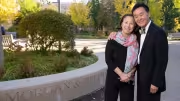
William F. Lee '72 (J.D.-M.B.A. Cornell '76), co-managing partner of the WilmerHale law firm, has been elected to the seven-member Harvard Corporation, the University's senior governing board. He will fill the position now held by James R. Houghton '58, M.B.A. '62, senior fellow of the Corporation; Houghton announced last December that he would step down at the end of this academic year, June 30. Lee, who had served as an elected Overseer, was vice chair of the Overseers' executive committee, the second-ranking position, during the 2007-2008 academic year. In that capacity, he served on the search committee that selected Drew Faust as Harvard's twenty-eighth president. Given his recent Overseer experience, he comes to his new responsibilities with relatively fresh exposure to the University's challenges and opportunities, during a period of sustained financial stress caused by the $11-billion depreciation of the endowment during the fiscal year ended June 30, 2009, and other losses related to investments and the funding arranged for construction (now suspended) in Allston.
The Corporation succession has attracted particular interest because, as reported, it comes at a time when the University's senior governing body is analyzing its operations and perhaps considering reforms ("The Corporation Changes," Harvard Magazine, March-April, page 52).
Lee's experience as an Overseer may be pertinent as the Corporation, which is self-appointing, considers how better to work with the larger, junior governing board; how to gather information more widely; and how to communicate with the University's diverse constituencies. "Self Improvement," a comment in the forthcoming May-June issue of Harvard Magazine, outlines some of the governance challenges facing the Corporation and management challenges facing Harvard's leadership; it should reach mailboxes by the final week of April, and should be available online by the middle of the April 19 week (see the John Harvard's Journal section). For an earlier roundtable discussion on University governance, including the views of two former Corporation members, see "Governing Harvard," published in the May-June 2006 issue.
In his law practice, Lee specializes in intellectual property and commercial litigation. He has served on the visiting committees to both Harvard Law School and the School of Engineering and Applied Sciences, and was a member of the committee that investigated relations between the Harvard University Police Department and the wider community, following complaints about the department's interactions with members of racial minorities.
The official news announcement of Lee's appointment appears here.