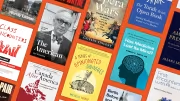
Reputation and Power, by Daniel Carpenter, Freed professor of government (Princeton, $29.95 paper). At a time of debate over government and regulation (oil spills or financial crises, anyone?), the director of Harvard’s Center for American Political Studies delivers the definitive (752 pages) analysis of the Food and Drug Administration and pharmaceutical regulation. He finds that such power “coheres well with the Federalists’ vision of ‘strong’ government” and that “the central criterion of strong governance is…legitimated vigor.”
The Shape of Inner Space, by Shing-Tung Yau, Graustein professor of mathematics, and Steve Nadis (Basic Books, $30). An exploration of the geometry underlying much work in string theory, by the scholar who made the decisive proof in the field, with a collaborating writer. Lay readers will still find the vocabulary and underlying ideas strange and challenging.
Never Pure, by Steven Shapin, Ford professor of the history of science (Johns Hopkins, $70; $30 paper). Few historians of science proceed from Woody Allen or Monty Python. But few review elegantly for the New Yorker and the London Review of Books. Shapin does all these things well, so it is rewarding to have this collection of his writings about the human nature of science, conducted as it is by people “struggling for credibility and authority.”
Modern Architecture: Representation and Reality, by Neil Levine, Gleason professor of history of art and architecture (Yale, $65). A sweeping “postmodern view” of architecture’s development across three centuries, profusely illustrated.
Taking Back Eden, by Oliver A. Houck ’60 (Island Press, $35). A Tulane law professor narrates eight landmark environmental lawsuits, including the one involving Con Edison’s power-plant plans for Storm King Mountain, along the Hudson, litigated by his College classmate, Albert K. Butzel (also LL.B. ’64).
Listen to This, by Alex Ross ’90 (Farrar, Straus and Giroux, $27). “[M]usic criticism is a curious and dubious science,” says its premier practitioner. This is the first collection of his New Yorker essays, following publication of his acclaimed book on twentieth-century classical music, The Rest Is Noise. (Ross was profiled in the July-August 2008 issue of this magazine.)
Exploring Happiness, by Sissela Bok, Ph.D. ’70 (Yale, $24). The author, now senior visiting fellow at the Center for Population and Development Studies, turns her attention from such past subjects as Lying, Mayhem, and Secrets to the nature of happiness and its representation from philosophy to contemporary science.
Shelter: Where Harvard Meets the Homeless, by Scott Seider ’99, Ed.D. ’08 (Continuum, $80; $22.95 paper). The author, an assistant professor of education at Boston University, studies the civic development of adolescents. One important example is the student-run Harvard Square Homeless Shelter, where opportunities arise to “do passion well.”
Laws, Outlaws, and Terrorists, by Gabriella Blum, assistant professor of law, and Philip B. Heymann, Ames professor of law (MIT, $21.95). A reflective critique of the war on terror, conducted in what the authors call a “No-Law Zone.” They aim to demonstrate that “the nation loses when either national security or the rule of law wholly vanquishes the other at a time of emergency.” For a perspective on the same problems by the authors’ Law School colleague Charles Fried and his son, Gregory, see “In the Wake of War,” page 36.
Handing One Another Along, by Robert Coles, professor of psychiatry and medical humanities emeritus (Random House, $26). Drawing from his “Literature of Social Reflection” (Gen. Ed. 105) course, the author pursues moral understanding through stories of others, drawn from literature and from his life, including meeting William Carlos Williams, the subject of his English thesis.
Facing Catastrophe, by Robert R.M. Verchick, J.D. ’89 (Harvard, $45). What better vantage point (unfortunately) for studying the subject than Loyola University’s law school, in New Orleans? The author offers an environmental-law perspective on disasters. He suggests respecting natural buffers, attending to public health and safety, and anticipating risks.
In Brown’s Wake: Legacies of America’s Educational Landmark, by Martha Minow, dean, Harvard Law School (Oxford, $24.95). The project of attaining equal educational opportunity regardless of race remains unfulfilled. But Minow finds that the impact of Brown v. Board of Education has been far wider—in the classroom, in society at large, and even in the global realm of human rights.