For the first 50 years of his life, Yellow Wolf preferred silence and solitude. As a boy, he journeyed alone into the mountains ringing Oregon’s Wallowa Valley, fasting until animal spirits appeared and gave him his power as a hunter and warrior: to strike like thunder, to sense enemies from far away. The spirits instructed him to fight alone whenever possible during his first and last war, waged from June to October 1877 between the U.S. Army and several hundred Nez Perce families who resisted leaving ancestral lands for an Idaho reservation. Yellow Wolf was 21 during the Nez Perce War. In the decades that followed, while his uncle Chief Joseph drew large crowds for speeches about the injustice of his people’s plight, Yellow Wolf said nothing of his months in combat, not even to his children.
But he spent his last three decades in running conversation. Exiled with Chief Joseph’s band to the Colville Indian Reservation in Washington, he began spending summers in the Yakima Valley as a migrant hops picker, earning a dollar a box. On his way home to the reservation in October 1907, he left an ailing horse with Lucullus Virgil McWhorter, a local sheep rancher. The next year, McWhorter returned the horse and invited Yellow Wolf and the rest of his band to camp on his land. McWhorter, who had moved west from Ohio specifically to be near Native Americans, tried talking with his guests. The children knew enough English to say that they were Chief Joseph’s band. McWhorter asked Yellow Wolf if he had fought in the summer of 1877.
Chief Joseph had died four years earlier. Yellow Wolf was 52. Despite fearing reprisals for the blood he had shed, he decided to find an interpreter. “I am going to say things, and I need you!” he told a young Nez Perce man fluent in English. “It is hard work for me—this talking. Like the heaviest lifting, it buzzes in my head!”
Yellow Wolf described himself as the son of a wealthy Nez Perce rancher and a woman who was close kin to Joseph. As a boy, he dreamed of being a warrior, designing a war club with a long handle so he could kill from the saddle. After his parents traded a horse for a 16-shot rifle, he hunted bear and buffalo. When he traveled home to Oregon from a hunt in Montana, he carried enough money to ride the last leg by stagecoach.
The Nez Perce War
McWhorter, like many Americans, was familiar with the Nez Perce War, when 750 men, women, and children outran and outfought the army across some 1,400 miles through the northern Rockies and the buffalo plains, only to be captured a day or two shy of the Canadian border. But Yellow Wolf caught McWhorter by surprise. For one thing, his story gave the lie to official accounts, which greatly exaggerated the number of Nez Perce warriors, covered up a vicious massacre of their women and children along the Big Hole River in Montana, and wrongly hailed Joseph as a battlefield genius, some combination of Achilles, Hannibal, and Napoleon. Joseph, Yellow Wolf maintained, was not a war chief, tending instead to the women, children, and elderly and to the horse herd.
Beyond the factual corrective, Yellow Wolf’s words had the allusive power of myth. At the conflict’s outbreak, he was untested and carefree. By the surrender, when he hid his rifle in his pants leg, crossed the army’s siege line, and escaped to Canada, he was a respected leader. His coming of age happened by degrees, from summer solstice to first snow, with each soldier he killed, each of his own narrow escapes from death, and every friend he watched die—with each new land that he encountered and every dream of the world he had left behind.
Yellow Wolf's Transition to Storyteller
The story inspired McWhorter to spend decades tracking down Nez Perce War survivors. He hired Yellow Wolf and other warriors to perform at rodeos and fairs so he could interview them during off hours. To maintain off-season contact, he hired them to make feathered headdresses for movie studios and theater companies: some of the first filmed Westerns may have featured war bonnets made by Yellow Wolf. McWhorter also took Yellow Wolf on extended road trips to battlefields, so he could map the events of the war. And with every hops harvest, the two men would sit down and talk.
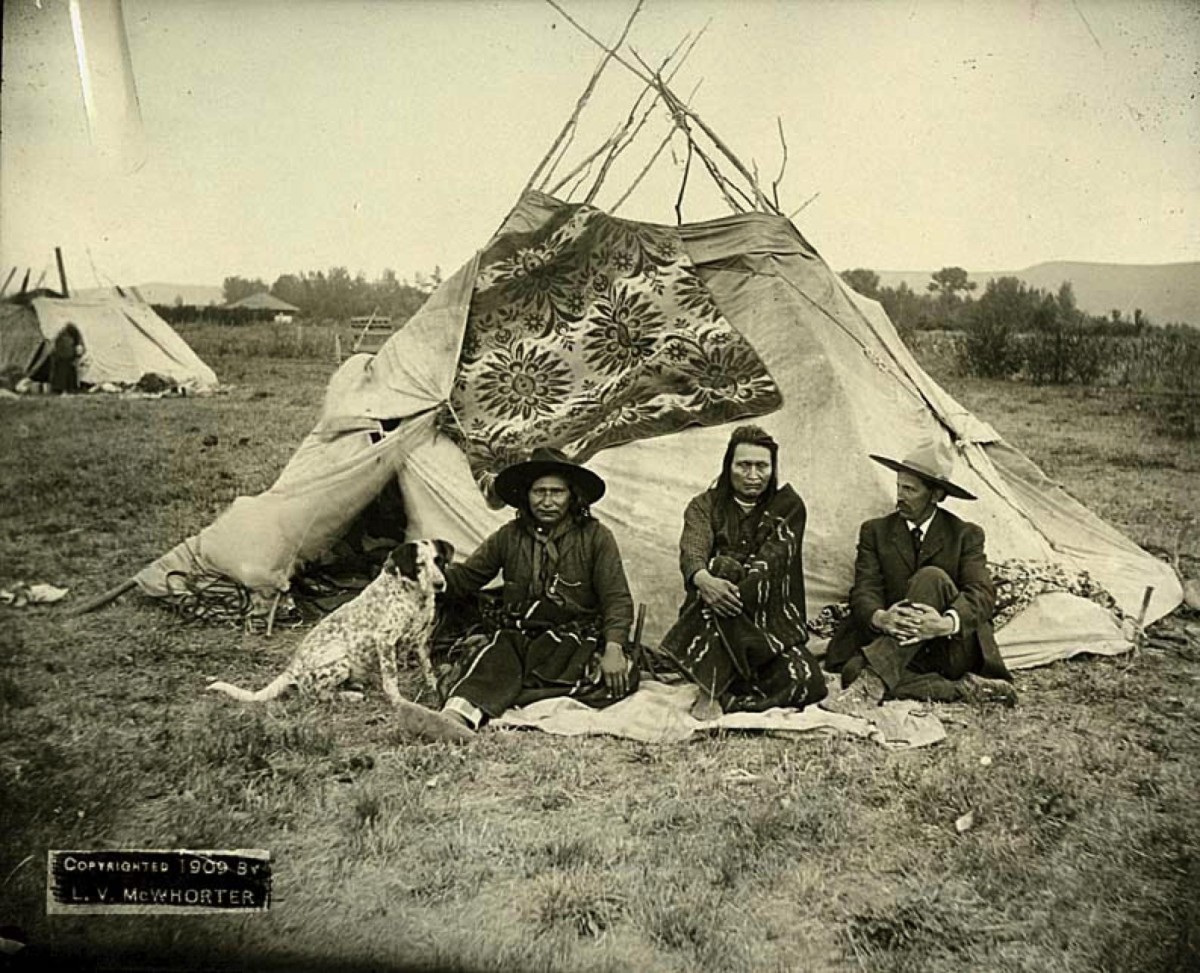
A snapshot taken in 1909 shows Yellow Wolf seated between rancher Lucullus McWhorter and their interpreter, Thomas Hart, a younger Nez Perce man who had served in the U.S. Army during the Spanish-American War and spoke good English.
Photograph courtesy of the Lucullus V. McWhorter Collection/Manuscripts, Archives and Special Collections at the Washington State University Libraries
After 25 years of conversation, Yellow Wolf hoped he would live to see the book McWhorter was writing. Nearing 80 and frail, he understood the power of his words. The government, he told McWhorter, had “robbed us of all our country, our homes. We got nothing but bullets.” But the stories he had held onto created an unimpeachable claim to land, liberty, and equality. “White people…are smothering my Indian rights,” he said. “The young generation behind me, for them I tell the story. It is for them! I want next generation of whites to know and treat the Indian as themselves.”
The Legacy of Yellow Wolf's Memories
He died five years before Yellow Wolf: His Own Story was published. McWhorter died in 1944, struggling to write a larger, more general history of the war. His papers went to Washington State University, which expected a few Indian artifacts for its “Treasure Room.” Instead, it received 26 linear feet of interview transcripts, correspondence, and other manuscripts about Nez Perce life, lore, and religion. The gift forced Washington State to change how it funded its library, and turned it, in essence, into a modern research university. The collection, rooted in Yellow Wolf’s words, is one of the most important archives of the Native American experience.