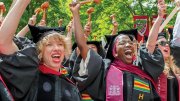
“A few weeks ago, I told a friend that the only thing that could go wrong today was the bad weather,” deadpanned graduating Law School student Patrick Healy at the start of his remarks at Wednesday afternoon’s Harvard Law School 2026 Class Day ceremony. “Like many times in the past three years, I was wrong.”
Until about 24 hours earlier, Healy had expected to be introducing the event’s scheduled keynote speaker, Boston Mayor Michelle Wu ’07, J.D. ’12. But on Tuesday evening, Wu cancelled plans to speak, citing an unwillingness to cross the picket line of an ongoing strike by Harvard’s graduate student union. And so Healy became the accidental headliner of a ceremony that wound up being almost entirely about the students themselves—their awards, achievements, and aspirations for the future.
About 30 striking members of the Harvard Graduate Student Union-United Auto Workers picketed the event, chanting and handing out flyers at the entrance to Holmes Field on the Law School campus, where the event was held. Once the ceremony began, union members marched silently off to one side of the stage. One speaker, Felipe Lobo Koerich, a graduating student and class marshal, offered a note of support from the podium.
“As a proud student worker all three years here,” he said, “I hope and trust that Harvard University will honor that contribution and live by its values.” A cheer rose from the audience.
In brief but poignant remarks, Healy—the first recipient of the new Dean’s Community Impact Award, given for fostering “community and connection” among students—urged his classmates to remember the profound moral obligation that their new law degrees carry. He recounted a recent conversation with a tourist in Harvard Yard who’d asked what he was studying and, after hearing he was a law student, told him he’d “always have a job.” Healy remembered thinking, “Is that all this degree means?”
The answer, he decided, was no. “As many of us have already done in clinics,” he said, “we can ensure that workers get their due, immigrants are treated fairly, prisoners live with dignity, tenants have steady shelter.” He urged fellow graduates to “actively orient” themselves to “a better world” in less tangible ways, too, by “listen[ing] instead of preventing others from speaking” and cultivating “patience for setbacks on the path to progress.” These actions are not cost-free, he acknowledged. “I’ve learned here,” he said, “that we can make all those changes and more if we risk something of ourselves—our convenience, our compensation, our comfort.”
Other speakers shared similar sentiments. “This degree is not ours alone,” said class marshal Gabriella Mestre, a child of Cuban immigrants who spoke of the generations of family support and sacrifice that enabled many graduates to reach Harvard Law School, and the responsibility those sacrifices conferred on their degrees.
Healy said he and his classmates’ outlook has been shaped by the turbulent “external events, internal disputes, and changing plans” that marked their three years at Harvard. This year’s graduates arrived in the fall of 2023, just weeks before the Hamas terrorist attacks that led to Israel’s war in Gaza, sparking months of protests and bitter division on campus. Much of last year was consumed with the Trump administration’s multipronged attacks on the University, including federal lawsuits— some of which are still ongoing.
Another speaker, class marshal Freija Haas, an international student from Sweden, recalled the frightening uncertainty for students like her a year ago amid the Trump administration’s attempts to revoke Harvard’s ability to host international students. Back then, “it seemed very unlikely,” she said, “that we would be here today…Our future was totally out of our hands.”
Lobo Koerich, too, alluded to the way recent upheavals in national politics have touched Harvard students’ lives and echoed Healy’s insistence on the obligation to serve the public. “As a gay Latino immigrant” and a naturalized citizen from Brazil, he said, “I’m only here on this stage because of the communities that stood with me.”
Noting the “persistent attacks” in recent years against queer, immigrant, and Latino communities in the United States, Lobo Koerich told fellow graduates, “These degrees matter. As we graduate from Harvard Law School, we have the opportunity—and, frankly, the duty—to help people, to do good.”