

Every reunion class has its superlatives. This year’s most senior honors went to William “Bill” Dubey ’46 and Linda Cabot Black ’51, who proudly donned red sashes signifying their status as the eldest alumni present as they led the parade into Tercentenary Theater on Friday, June 5.
Black, now 97 years old, received her bachelor’s degree from Radcliffe College more than four decades before the school formally merged with Harvard, coming to the University in the midst of World War II. She knows the title well, having boasted the red sash as Radcliffe’s oldest alumna in 2022, 2024, and 2025.
Black, originally from Weston, Massachusetts, came to Radcliffe to study music—a choice motivated in part, she said, by her Harvard-educated father.
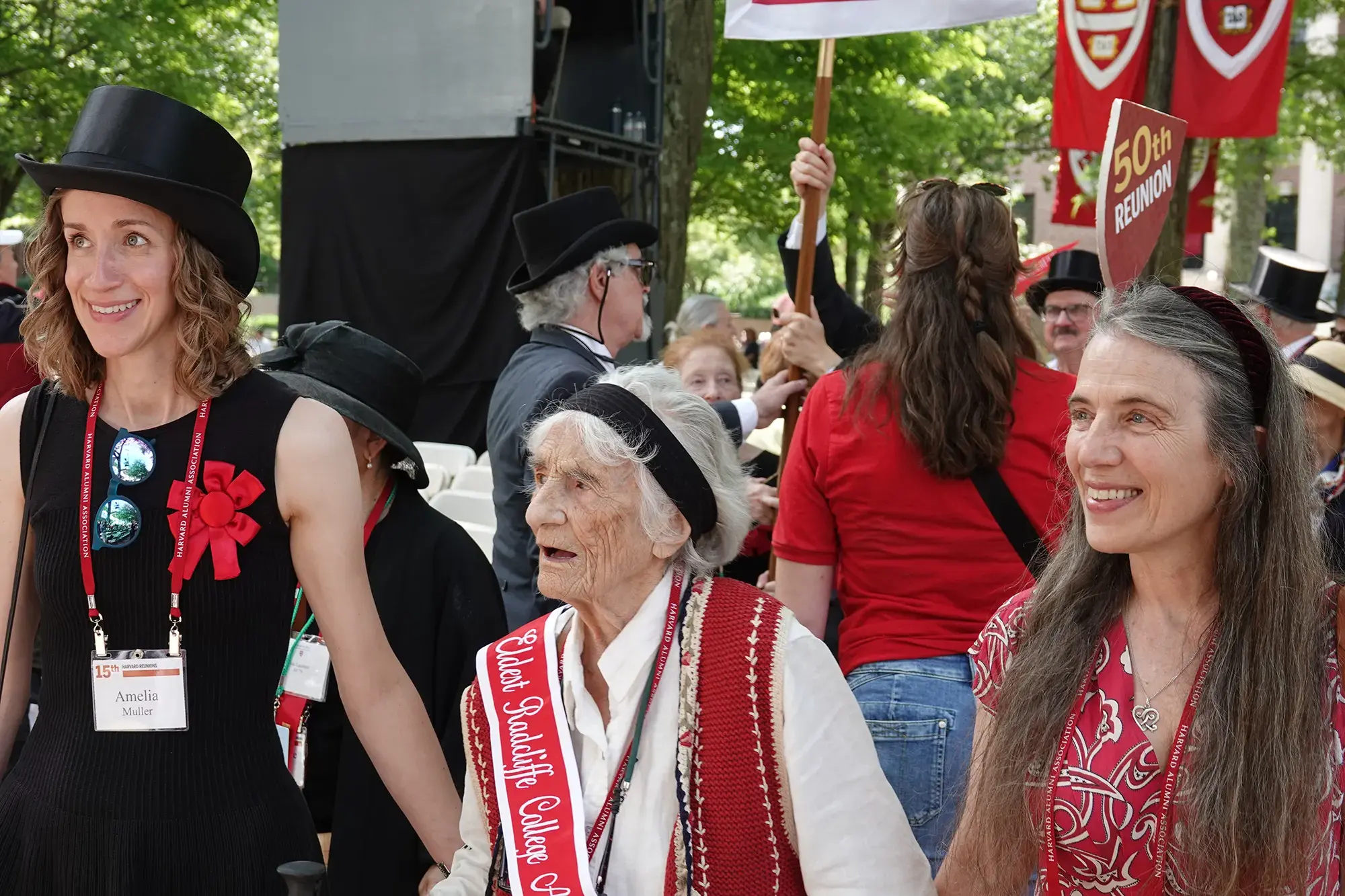
“I have a father who knows everything about everything,” she said. “I had to major in something that he knew nothing about, and there were only two things in the world: music and art.”
But Black, who worked professionally as an orchestra producer, said she was never a musician. Instead, she spent much of her career as an advocate for music and music education. After graduating from Radcliffe, she served as a longtime board member of the Boston Lyric Opera and organized a tour of opera for children and families across New England.
When asked how it felt to return for a fourth stint as the oldest of her classmates, Black was concise: “fine.”
Black attended the day’s festivities with her daughter Sophie Cabot Black, and the pair said they had been inspired by Dubey, who flew in for the day’s festivities from San Diego, California, with his son.
“You’re sitting in the front row surrounded by these very old men in wheelchairs,” Black said, but Dubey was notably inspiring “because he wasn’t in a wheelchair,” despite being 101 years old.
It was a first-time honor for Dubey, who said he was “sort of overwhelmed” by all the attention he had gotten. “I don’t think of myself as 101.”
Dubey began studying at Harvard in 1940 and served in the Navy V-12 program, an accelerated initiative to train World War II officers. He returned to Harvard on the GI Bill after being discharged in 1946, and received his degree months later.
“My class was really screwed up, leaving almost immediately after they entered—those that were drafted and missed—and so anyone who got a degree in the draft got it between 1945 and 1950.” Dubey said. “At any rate, I’ve always regretted the fact that I have a rather short Harvard experience.”
His service got a nod from Alumni Day speaker Johnny Kim—a Harvard Medical School graduate, NASA astronaut, and fellow Navy officer.
“You should be up here. I want to hear what you have to say,” Kim said, thanking Dubey for his service and wishing him a happy birthday. Dubey will celebrate his 102nd birthday in August.
He returned for a four-month program to study communication after receiving his bachelor’s degree. Although there “wasn’t very much studying,” he said he found a love for the arts—something he has carried on for decades. Dubey said that, upon returning home to California, he will be performing a one-man version of the comic opera The Mikado at his senior living facility.
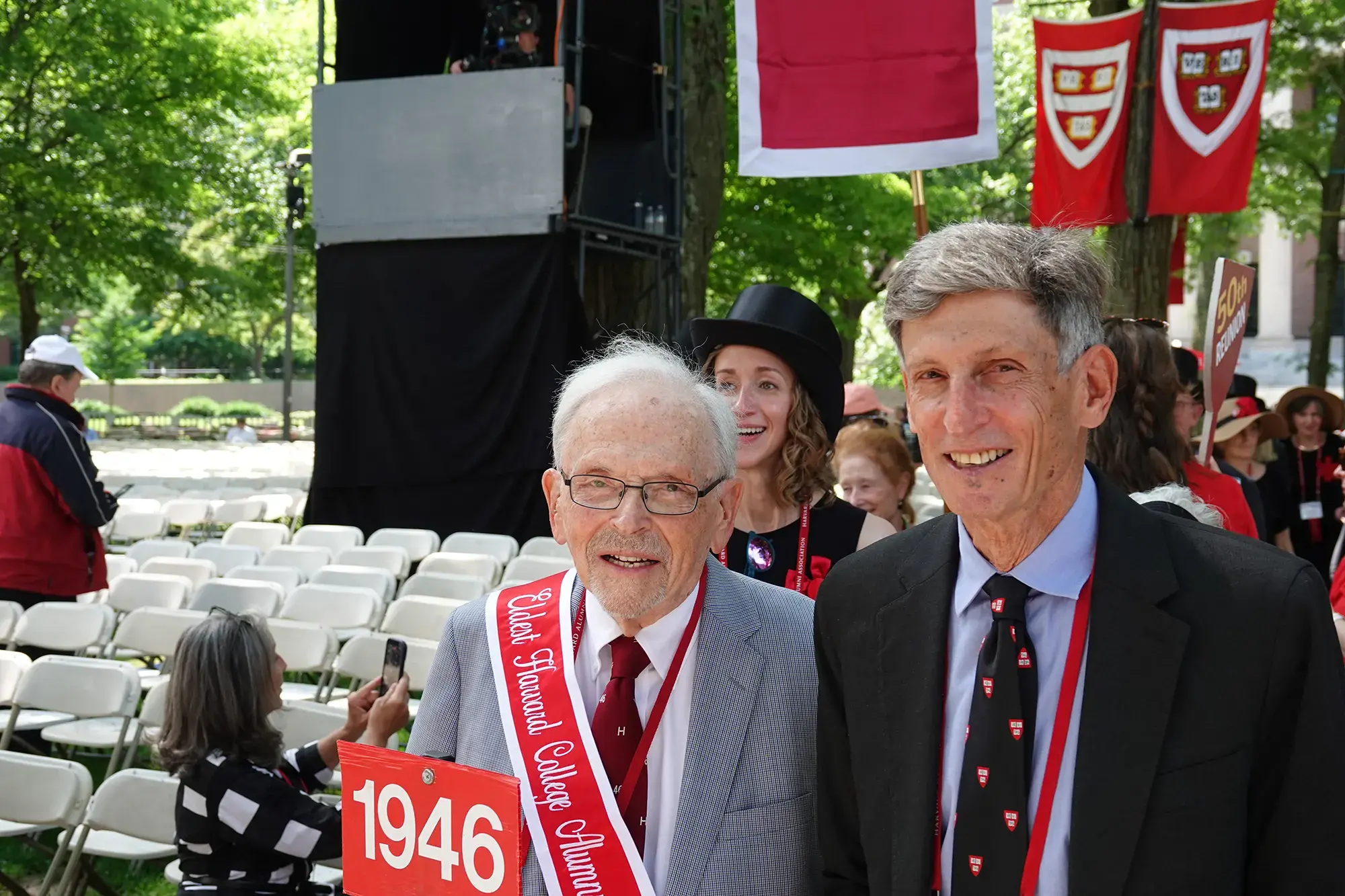
Dubey spent nearly 30 years working in the packing industry, before pivoting in his 50s to lead Camp Rising Sun, a youth leadership camp that he once attended. He served as the camp’s director for a decade until he left in 1986 to become the executive director of Opportunity to Learn, a nonprofit that helps improve language and literacy skills for high school students learning English.
He said the Camp’s “DNA is DEI,” and that the Trump administration’s attacks on Harvard last summer struck a particular chord.
“I’ll tell you this: when all the trouble began with the administration, I was very, very upset,” he said, adding that he was “proud to be” a Harvard alum.


