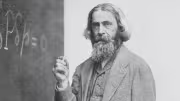
The magnum opus of the late John Rawls, Conant University Professor, was A Theory of Justice (Harvard University Press, 1971), now regarded, according to the Cambridge Dictionary of Philosophy, as “one of the primary texts in political philosophy.” It advanced the idea of justice as fairness. Rawls himself is taken to be the most important political philosopher of the twentieth century.
Undaunted, a company of merry Oxford undergraduates wrote, composed, produced, performed to great acclaim, and is taking on the road a musical comedy (yes, comedy) entitled A Theory of Justice: The Musical! Amaryllis Barton reviewed it in The Tab Oxford (as the production was wowing Oxonians from January 30 through February 2 this winter) as “an all-singing, all-dancing romp through Western thought.”
“Whilst I may not be convinced of John Rawls’ theory of justice,” wrote reviewer Robert Holtom, “I am more than convinced that the musical version was utterly brilliant—the energy, ingenuity, and intelligence was there from the start, accompanied by a catchy score, some exceptional singing, and even some philosophical jokes.”
“Opening in 1970s Harvard,” wrote critic Gavin Elias, “the play centers on Rawls’… quixotic quest to revitalise political philosophy with an encompassing ‘theory of justice.’ Inspired (and aroused) by a beautiful student…with a penchant for eminent philosophers, he sets out to establish that ‘justice is fairness,’ only to see his newly found muse/love-interest sucked into a time vortex that bursts into being in the college quad. Cue a madcap voyage through philosophical history as Rawls encounters, questions, and debates intellectual giants such as Plato, Rousseau, and Kant on his search for both the student Fairness and the inspiration for his magnum opus. He is not alone, however, as his ideological nemesis Robert Nozick...sets off in hot pursuit to sabotage his theory, egged on by his malevolent lover, Ayn Rand.…Never before has philosophy been as flat-out fun.”
One of the show’s writers, Eylon Aslan-Levy, tells Primus the show will be part of this year’s Edinburgh Festival Fringe, the world’s largest arts festival, and will run from July 31 through August 26 at C venues, Chambers Street. Now how about a Harvard production, somebody?
Any challengers? Shortly before his death in March, George M. Burditt ’44, LL.B. ’48, of La Grange Park, Illinois, sent Primus this dispatch extolling his College class, of which he was first marshal. “The class of 1944, with due humility, claims to be Harvard’s most outstanding class since 1636. Of course, the members of our class are all in the Greatest Generation, but we have several other more specific claims to fame—and challenge other classes who may dispute our temerity. Here is the tip of the iceberg:
• We have four Nobel Prize winners. We haven’t checked it out, but we doubt that any college class in the world has four Nobelists. We have one in physics, two in economics, and one in medicine.
• We have the longest-serving class secretary in history, Dan H. Fenn Jr., A.M. ’72, of Lexington, Massachusetts. [Full disclosure: Primus is a third cousin of Fenn’s.]
• I believe we have two state Supreme Court justices and other successful movers and shakers in government.
• We had one of the very top spies for Russia in World War II.
“Since we are now 90 years old, I didn’t want these facts to go relatively unknown to present and future generations.”