Visitors to Harvard Business School (HBS) know its corridors are enriched with a significant, thought-provoking, collection of contemporary art (see “Rethinking the Walls,” January-February 2013). Now the grounds are enlivened as well: not only with new edifices and lush landscaping, but with a temporary installation of four sculptures on loan from contemporary artists. On the Spangler lawn, shown above, Ernest and Ruth (2015), a whimsical, open-ended cartoon balloon in steel plate and pipe, by Hank Willis Thomas, invites passersby to fill in the blank—or avail themselves of what is a bench, too. Framed in the distance is Tony Tasset’s Arrow Sculpture (2015), in painted aluminum. The artist describes the work as a graphic emblem of trending, suited to the contemporary environment of chronic evaluation; perhaps, subliminally, the business-leaders-to-be will absorb a message about quarterly earnings—and the resulting movement of stock prices. (Jaume Plensa’s Inés, 2013, appears below, on the Aldrich lawn.)
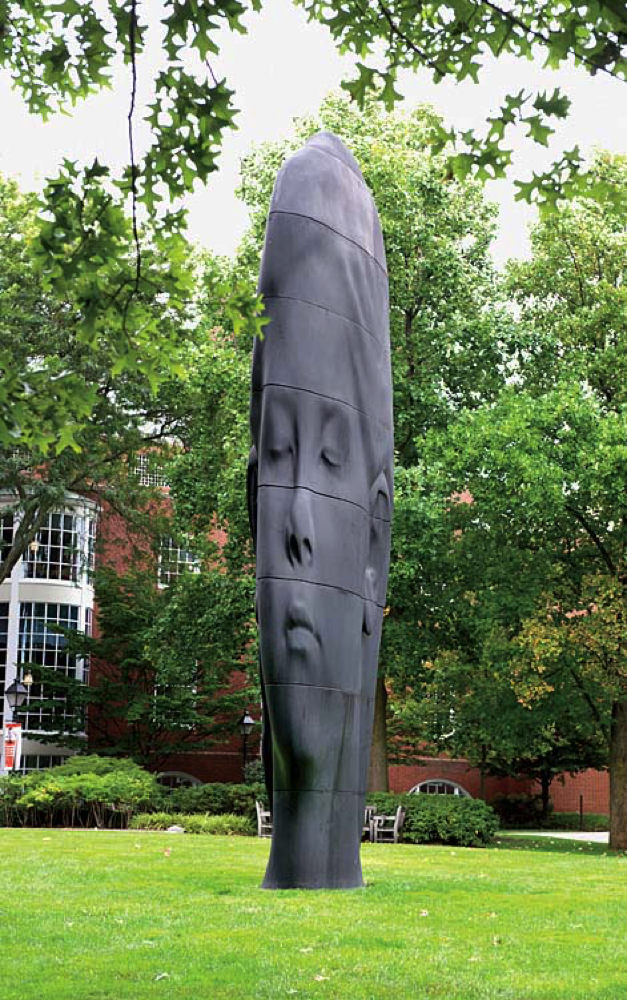
Photograph by Jim Harrison
“We’ve been doing a lot of things over the past few years to activate our outdoor spaces,” said Gabe Handel, assistant dean for administrative and educational affairs. Placing tables and chairs on the Spangler lawn, for example, changed it from a transit way to a popular social space—even a venue for al fresco classes. Now that appeal is augmented. “Art has been so successful indoors in activating the campus,” he continued, “we thought it belonged outside, too.” The first loaned works were installed last April, as spring beckoned; new sculptures, chosen by a committee of staff members and students interested in art, will rotate in next April, sparking renewed visual excitement. Temporary exhibits, Handel noted, encourage those who like a sculpture to cherish it, fleetingly; those who don’t will be mollifed relatively quickly. HBS, he said, is eager to convey both that it is rooted in tradition and that it is “very innovative,” and “art is a wonderfully visible symbol of that.”
On a University campus known for its cherished mix of green lawns and red brick, and its relative paucity of outdoor art, perhaps HBS’s artistic entrepreneurship will plant a welcome aesthetic seed.