The 1959 Radcliffe Quarterly article begins oddly: it was written, explains its author, “by way of expiation for not having fulfilled expectations in the field for which Harvard scientists in the Museum on Oxford Street prepared me.” Late in life, Millicent Todd Bingham, Ph.D. 1923, felt the need to justify her dramatic professional pivot. Her public rationalization belied private angst.
She was the daughter of highly accomplished—and highly complex—parents: astronomer David Peck Todd, who taught at Amherst and became internationally known as an eclipse chaser before mental illness forced his “retirement” and institutionalization, and Mabel Loomis Todd, perhaps best remembered as Emily Dickinson’s first editor (or for her affair with Dickinson’s brother). Though her relationship with each parent was difficult in different ways, Millicent was also significantly influenced by their disparate professions.
The contrasts between their work unwittingly set up a dynamic that profoundly confused her childhood and preoccupied her life. In 1887 her father taught her how to take and record the daily temperature. Seventy years later she stated, “I don’t know whether it was because he wanted the temperature, or…to teach me to be methodical and systematic.” Whatever his intent, David instilled in his only child a lifelong emphasis on rigor and the importance of studying the natural world. That same year her mother, diligently deciphering and transcribing the poems discovered after Emily Dickinson’s death, also pressed Millicent into service: “Initiation into the vagaries of Emily’s handwriting,” she wrote later, “is one of the earliest rites I can recall.”
Despite “very hit or miss” home-schooling, she attended Vassar, graduating in 1902. Then she floundered, teaching French at Vassar and Wellesley, studying arts in Berlin, and traveling the world with her parents tracking eclipses. Torn between science and the humanities, she feared becoming a dilettante.
A 1907 eclipse expedition to Peru eventually proved a turning point. It would take almost a decade, and the example of Ellen Churchill Semple, later the first female president of the Association of American Geographers, but in 1916 she began graduate studies in geography at Harvard, where an interdisciplinary program included coursework in geology and anthropology. She left in 1917 to join the war-relief effort in France, working at a hospital and beginning a love affair with a U.S. soldier she tended. But once the war and the romance ended, she retreated to Harvard. “I felt that emotion would never be revived. There was nothing but work—hard work—for me,” she wrote of her 15-hour days in the lab. Peru’s well-remembered rugged geography became the topic of her dissertation—she would be the first woman to earn a Ph.D. in her department—and the subject of her first book. “To the charm of limitless nature is added the mystery of great peoples destroyed before they were known,” she wrote. “Contrasts of nature, of people to country, of antiquity to the present—these diverse elements are insistent wherever one turns.”
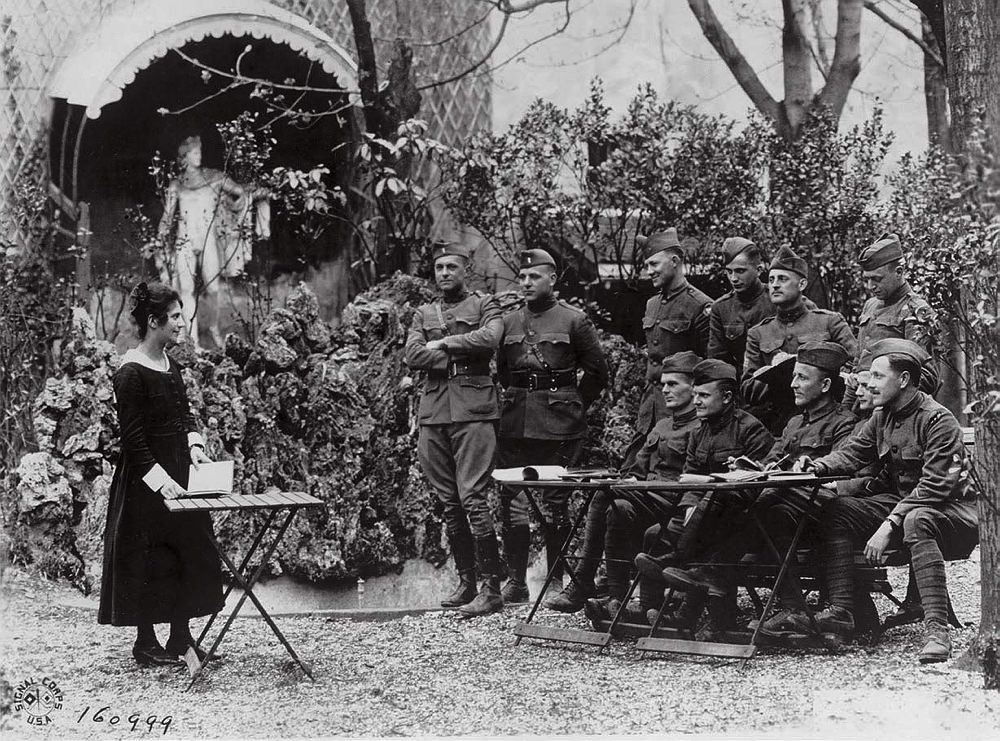
In a 1918 photograph, she teaches French to U.S. troops in France.
Photographs courtesy of the Todd-Bingham Picture Collection (MS 496E). Manuscripts and Archives, Yale University Library
The 1920s roared for her. She met and married psychologist Walter Van Dyke Bingham, A.M. 1907, a pioneer of intelligence-testing theories; landed part-time teaching jobs at Columbia and Sarah Lawrence; and published frequently. Finally, it seemed, her direction was clear.
But in 1929, her mother needed her. Years earlier, Mabel Todd had abruptly ceased editing Dickinson’s poetry due to financial and personal disputes, locking away more than 600 unpublished poems for 30 years. As the centennial of Dickinson’s birth approached, Todd felt it time to retrieve the poems, but she also knew, having suffered a cerebral hemorrhage, that she could no longer edit them alone.
“It is all wrong, Millicent, everything that has happened. Will you set it right?” she asked her daughter, Bingham would later write in her book, Emily Dickinson’s Home. “I said I would try. A simple question and a simple answer. I did not know what I was promising.” But she did know that a switch from geography to Dickinson at 49 would likely never yield prominence in either field. With great hesitation and not a little ambivalence, she consented.
What she had promised became all-encompassing—especially after her mother’s death in 1932 left her with the unpublished poems and three other books’ worth of related Dickinson materials to write. Her pledge also launched a decades-long fight with Harvard over the copyright to Dickinson’s poems, and eventually, the division of Dickinson manuscripts between Harvard and Amherst.
Bingham received mostly solid reviews for her meticulous research and books, and two honorary degrees. Yet the decision to abandon her Harvard training and turn to literary analysis forever haunted her. “Natural science…would teach me to be exact and honest,” she mused in one paper, “Training the Mind,” even though “…the field of letters into which as a final focus of effort I am plunged” aligned with her “inclination.” But her “intellectual quest,” she worried, had gone undefined. “Decidedly I am not a professional.”
Unsurprisingly, she titled her Quarterly valedictory “A Moment of Drama.” But it’s also not surprising that she closed in a way that provided both rationalization and accommodation: “During the work of a quarter of a century and more I have discovered one supreme fact, namely that in renouncing my study of the wonder and mystery of creation, the mystery has not departed. Emily Dickinson remains. The wonder as revealed in earth and sea and sky is not as remote from the life of one woman in a New England village as it might seem.”