Campus turmoil tumbled into Robinson Hall during the 1969 strike, when students turned the building into a factory for the production of T-shirts bearing the memorable clenched-red-fist logo. Until then, many in the Harvard community probably never noticed the building tucked into a far corner of Harvard Yard, nor realized that it housed the Graduate School of Design. For a premier professional school, the GSD had maintained a markedly low profile during its years in the historic 1902 structure designed by McKim, Mead & White.
 But Robinson's classrooms and its offices seethed with inner turmoil long before the striketurf wars and personality clashes among faculty members in landscape architecture, architecture, and planning, all vying for space, funding, and students and battling over pedagogical issues with broad artistic and social implications. At last, this story is told in a new book, The Struggle for Modernism: Architecture, Landscape Architecture, and City Planning at Harvard, by Anthony Alofsin '71, M.Arch. '81. The book documents a part of Harvard history that is remarkable because the GSD and its powerfully positioned graduates have played such a major role in charting the course of professional practice and design education in America and in shaping the landscape itself during the last century.
 |
 |
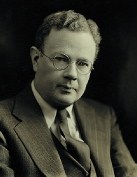
| Dean Joseph Hudnut of the School of Design, and Robinson Hall. Its serene exterior concealed sharp disagreements over modernism, history, and the role of planning. |
| Harvard University Archives |
Alofsin, who teaches in the Architecture School at the University of Texas, embarked upon the project more than a decade ago, because, as he says, "The GSD was oblivious to its own history." At a recent symposium in Austin honoring the book, Peter E. Walker, M.L.A. '57, observed that such institutional amnesia is not a good thing. "I could have used that book," he said, noting that it finally provided him with answers to questions that had mystified him while he taught at the GSD between 1958 and 1987 and chaired its landscape departmentquestions such as how his department could be "the most prestigious in America" and also broke, or why so many notable architects and landscape architects were teaching there for free.
Walker's fellow panelist, Henry N. Cobb '47, M.Arch. '49, former chairman of the architecture department (1980-1985), concurred. He praised the book in particular for its fine portrait of Joseph Hudnut, the GSD dean who brought Walter Gropius to Harvard in 1937 to head the architecture department, only to be overshadowed by the Bauhaus founder ever after. The initial close rapport between the two turned into bitter rivalry as Gropius advanced the cause of International Style modernism and Hudnut faulted the modernist agenda for draining the life from cities. Gropius may have attracted the best students to Harvard, but his influence was limited, Cobb said, because he taught only one small master class and "most of us never saw him at all." Furthermore, according to Cobb, most students at the time were more captivated by Le Corbusier.
Hudnut and Gropius also split over the importance of history, a subject that nearly disappeared from the GSD curriculum during their tenure. Hudnut believed in a strong liberal-arts education, including history, as a prerequisite to graduate study in architecture. But, as Cobb put it, Gropius argued that studying history might "suffocate individual creativity."
Those who do value the lessons of history will welcome Alofsin's book. It provides the first detailed account of how and why Harvard incorporated design into its various teaching programs, why from its earliest days the GSD was searching for "star" professors (and why the stars were so rarely Americans), and why efforts to create real collaboration among the disciplines repeatedly failed. It also points to explanations for why the GSD evolved into such an insular place, why architects came to think of themselves as the undisputed leaders of design "teams," and how they marginalized landscape architects and plannersfinally prompting the planners to exit en masse for the Kennedy School in 1980.
The GSD has assumed a much more public profile since it moved to Gund Hall in 1972. It has also reinvented its planning program recently. Is it possible for architects to maintain a design vision and still collaborate with planners and landscape architects, not to mention engineers and security experts? Can design professionals find a political voice, or will they all find themselves on the margin in an era of rapid change? It's time to start the sequel.
Jane Canter Loeffler, M.C.P. '71, is an architectural historian and urban planner in Washington, D.C., and a visiting associate professor at the University of Maryland. She is the author of The Architecture of Diplomacy: Building America's Embassies (Princeton Architectural Press, 1998).