He has run for political office, been a professor, published seven books, modeled, and acted in dozens of commercials, but Alexander Karanikas '39 doesn't plan to slow down anytime soon. At 86, he hopes to publish more of his novels and short stories and an autobiographyand is working on a movie deal to further develop the screenplay that won him the Neptune Award at the Moondance International Film Festival, held in May in Boulder, Colorado (www.moondancefilmfestival.com).
That award is presented each year to a filmmaker over the age of 75 who "continues to strive for excellence in his or her career" and "inspires and encourages others by his or her example." Karanikas won for "Marika," based, he says, on the true story of 57 women from the Greek province of Suli who, facing capture by an Ottoman army in December 1803, chose to leap from the cliff of Zalongo to die, rather than be enslaved. "The whole idea of the 57 women committing mass suicide rather than being captured has haunted me for a long time," he says. "I've been looking for a way for them to come out of the past and speak to the world about their agony."
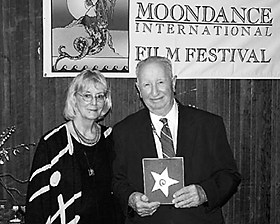 |
| Alexander Karnikas accepts the Neptune Award from Moondance International Film Festival founder Elizabeth English. |
| Photograph by Stanly Parks |
The answer came in several steps. First was a poem, "The Song of Zalongo," which he wrote in the 1940s; it was published 10 years ago in a collection called Stepping Stones. But Karanikas believed there had to be a more dramatic and complete way to recognize the event. Decades after he'd written the poem that served as its springboard, he created "Marika," focusing on a fictional member of the group and telling the story of her love, heroism, and tragedy.
A friend familiar with Moondance told him that the screenplay, with its powerful female protagonist, would be perfect for the festival, which aims to celebrate women as artists as well as subjects of art. "Those brave women of Suli have been celebrated in art, in song, and in the folklore of a nation," Karanikas said in his acceptance speech at the festival. "Now, hopefully...they may also be celebrated in film."
He is working with Moondance to find an agent and a producer. It's not easy to put together a movie, he says: you need a producer to create your package, a star, and a staff. As an accomplished actor himself, he should know. He agrees that he has his work cut out for him, but says Harvard helped give him the tools he will need: it "did for me what it did for everybodysharpened their intelligence, gave them confidence for their future."
Karanikas is excited about bringing to film a story that embodies a subject he cares deeply about. "This took place during the Romantic Movement, when many countries were searching for national identities and fighting for their freedom...the Greeks especially," he says. What makes "Marika" resonate even more, he adds, is that it represents the struggle for Greek freedom but also symbolizes women's battle against domination by men.
"This is one of those events in history that has empowered women and has given them a very high, I would say illustrious, position in terms of their courage in the face of tyranny, in the face of male chauvinism," he says. "These women, by sacrificing their lives, in a way symbolize all women faced with a humiliation at the hands of men...they dramatized the price that sometimes has to be paid for that kind of liberty."
~Laura L. Krug