Amid Tradition, a Symbol of Change

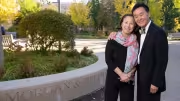
The New York Times profiles Nicole M. Parent ’93, the first female president of the Harvard Club of New York City, which did not even admit women until 1973...

The New York Times profiles Nicole M. Parent ’93, the first female president of the Harvard Club of New York City, which did not even admit women until 1973.

Parent, a managing director at Credit Suisse, speaks about her efforts "to respect the club’s tradition while broadening the membership to make it resemble Harvard itself." She says: “You have to take a step back and realize that the default answer to everything can’t always be, ‘We do it this way because we’ve always done it this way.’ ”

Read the story: Decor is Crimson, and the Ceiling Isn’t Glass
Related topics

You might also like

Novelist Lev Grossman on Why Fantasy Isn’t About Escapism

The Magicians author discusses his influences, from Harvard to King Arthur to Tolkien.

Yesterday’s News

A co-ed experiment that changed dorm life forever

A Congenial Voice in Japanese-American Relations

Takashi Komatsu spent his life building bridges. 

Most popular

Why Men Are Falling Behind in Education, Employment, and Health

Can new approaches to education address a growing gender gap?

Sign of the Times: Harvard Quarterback Jaden Craig Will Play for TCU

Out of eligibility for the Crimson, the star entered the transfer portal.  

Explore More From Current Issue

An axolotl with a pale body and pink frilly gills, looking directly at the viewer.

Regenerative Biology’s Baby Steps

What axolotl salamanders could teach us about limb regrowth

Four young people sitting around a table playing a card game, with a chalkboard in the background.

On Weekends, These Harvard Math Professors Teach the Smaller Set

At Cambridge Math Circle, faculty and alumni share puzzles, riddles, and joy.

Historic church steeple framed by bare tree branches against a clear sky.

Harvard’s Financial Challenges Lead to Difficult Choices

The University faces the consequences of the Trump administration—and its own bureaucracy