
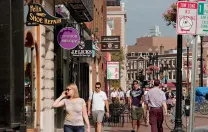
Oldest and newest Harvard Square businesses

The lists below include many of the oldest and newest Harvard Square businesses

Return to main article:

The lists below include many of the oldest and newest Harvard Square businesses, according to information provided by the Harvard Square Business Association.

Oldest

  • Cambridge Savings Bank (1834)
  • Cambridge Center for Adult Education (1876; a nonprofit, rather than a business)
  • Harvard Coop (1882)
  • Leavitt & Peirce (1883)
  • Cambridge Trust Company (1890)
  • J. August (1891)
  • La Flamme Barber Shop (1898)
  • Alice Darling Secretarial Services, Inc. (1913)
  • Felix Shoe Repair (1913)
  • Dickson Bros. True Value Hardware Store (1920)
  • Brattle Square Florist (1925)
  • The Sheraton Commander Hotel (1927)
  • Grolier Poetry Book Shop (1927)
  • Harvard Book Store (1932)


Newest (2010 and 2011)

  • Follow the Honey
  • Al’s Sandwich Shop
  • Chutney’s
  • Clover Food Lab
  • Forty Winks
  • Hotel Veritas
  • The Maharaja 
  • Otto Pizza
  • Pinkberry
  • Russell House Tavern
  • Starbucks Harvard Square (bi-level store)
  • TD Bank 
  • Zinneken’s 

Most popular

New Names Proposed for Harvard Extension School Degrees

Long pushed for, the changes would be part of a broader rebranding for the Division of Continuing Education.

Harvard Academic Workers Begin Strike

A second union joined graduate students on the picket line, emptying labs and classrooms.

Harvard Weathers a Year of Turmoil

The federal government has launched unprecedented actions against the University. Here’s a guide.

Explore More From Current Issue

A smiling man in a brown plaid suit stands outdoors with greenery in the background.

The professor and former Harvard College dean is the next president of Harvard Magazine’s Board of Directors

Two fans celebrate in front of a TV showing a football game.

A new Harvard Kennedy School project aims to harness the power of feral fandom.

Bronze statue of a seated figure holding a book, with a campus setting in the background.

As humanities shrink across higher education, one department is flourishing. Is its success a fluke, or a roadmap?