
“In 1999, I was like, ‘I’m going to be a storm chaser,’” says Harvard’s lead piano technician Mariana Quinn, who oversees the maintenance of the University’s more than 200 pianos. Although her father was a piano technician and musician, she had no desire to enter the family business. She took one geological sciences course in college and thought, “I’ve found my niche.” But in 2005, she was working as a geological mapper for the Oregon Fish and Wildlife Service when her father died and “everything changed.” Suddenly, she realized that she wanted to “honor his legacy and follow in his footsteps.” She enrolled in the same piano technician program he’d once attended, Boston’s North Bennet Street School, and learned to tune piano by ear in the same rooms he had. “It helped the healing process,” she says. “I felt much closer to him.” Quinn is a music aficionado—the only genres she doesn’t care for are zydeco and “easy listening”—but unlike her father, she’s not a musician. “I played flute as a kid, but that’s barely worth mentioning,” she says. Tuning, however, is a scientific, experimental process for her, “like trying to fit pieces into a puzzle with definite borders—in this case, octaves.” Analytically minded, she says she’s “not a spiritual person at all, really,” but she admits piano tuning has brought her experiences she can’t explain. Her first six months as a technician, she tuned the pianos of her father’s former clients—the last ones he ever serviced. Improbably, every piano was still perfectly in tune, as if her father were still looking out for her. She teared up. “I remember thinking, is he still here with me?”
Tuning Pianos with Mariana Quinn
A former geologist follows her piano-tuner father’s footsteps.

Mariana Quinn
Photograph by Stu Rosner
You might also like

Resculpting an Empire, Through Kitchen Scraps
Artists Enzo Camacho and Ami Lien turn a colonial symbol from Cambodia inside out.

Boston Ballet’s Ming Min Hui on Changing Audiences and Timothée Chalamet
The outgoing executive director and Harvard Business School graduate went from dancing The Nutcracker to growing a ballet company.
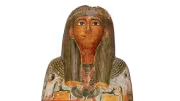
Padimut at Harvard
A rare Egyptian mummy case is on display at the Harvard Museum of the Ancient Near East.
Most popular


Explore More From Current Issue

The Harvard triathlete and coach says she helps normal people to “do extraordinary things.”

These newly released novels, histories, and memoirs grapple with identity in all its forms.

Artists Enzo Camacho and Ami Lien turn a colonial symbol from Cambodia inside out.