For many years, the brick pathways connecting the graves of Harvard’s earliest presidents lay hidden beneath grass, ivy, and weeds in Cambridge’s Old Burying Ground. In November 2025, a group of Harvard undergraduates from the Hasty Pudding Institute cleared away the overgrowth and brought them back into the sunshine.
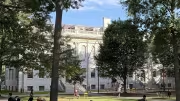
The Old Burying Ground is one of Harvard Square’s most historic sites. Established around 1635, it was the University’s earliest cemetery and the final resting place for some of its first leaders. Among the graves cleaned by student volunteers were those of eight former presidents of Harvard College.
Among the prominent people buried there are Henry Dunster, Harvard’s first president, who helped stabilize the fledgling College and secure its early charter (Dunster House is named in his honor); Charles Chauncy, his successor; Urian Oakes and John Leverett, who led the College through the late seventeenth and early eighteenth centuries; and Benjamin Wadsworth and Edward Holyoke, each of whom guided the institution through periods of growth in the eighteenth century. Joseph Willard and Samuel Webber, late-eighteenth and early-nineteenth‑century presidents, are also buried on site.
The cemetery’s graves tell broader stories as well. The earliest headstones, some featuring winged skull motifs (often called “death’s heads”) were common in seventeenth‑century New England. These symbols reflect beliefs about mortality and religion during Harvard’s earliest years and offer historians and students insight into attitudes toward death and social status in the early colonial period. The burial ground also holds the remains of Revolutionary War soldiers from Cambridge, as well as members of prominent early Cambridge families whose names still appear on maps and institutions throughout the city.
The site is also the resting place of two enslaved women, Cicely and Jane, as well as Charles Lenox, a free Black entrepreneur from the eighteenth century who worked for the University, and his daughter, Susan. Philips professor of archaeology and ethnology Jason Ur and Johns Hopkins University professor Aja M. Lans are in the process of documenting racial segregation in the Old Burying Ground cemetery to reveal colonial-era burial patterns in New England.
The project was identified by the Harvard Square Business Association (HSBA) as a community service opportunity for the students, who are required to complete four hours of service as part of their Hasty Pudding membership. During a six-week period from mid-October through late November, they returned repeatedly; HSBA executive director Denise Jillson said several students devoted 20 to 30 hours to the project.
While the Hasty Pudding Institute is best known for its theatricals, it also garners national attention for its annual Man and Woman of the Year celebrations. The 2026 honorees are actor Michael Keaton (Batman, Batman Returns, Beetlejuice), who will be roasted by Hasty Pudding Theatricals on February 6, and actress Rose Byrne (Bridesmaids, If I Had Legs I’d Kick You, Troy), whose celebratory roast and presentation of the Pudding Pot will take place on February 13 at Farkas Hall.
The main cleanup of the cemetery—ripping away vegetation, digging out unwanted shrubs, and scrubbing gravestones to make their inscriptions readable again—took place before Thanksgiving. Melanie Goldberg ’26 and Noah Basden ’26 coordinated the effort, organizing volunteers and overseeing work on site.
Their work was part of a larger collaboration among the Cambridge Historical Commission, Harvard, Cambridge Department of Public Works, First Parish, and the Christian Science Reading Room, who began coordinating efforts to revitalize the Old Burying Ground in the summer of 2025 after observing the extent of overgrowth in the cemetery. Through the coordinated efforts of those groups, all 1,200-plus grave markers were surveyed and inventoried, preserving historical records even where the inscriptions had eroded.
On November 25, two days before Thanksgiving, Basden was still at work in the cemetery, said Jillson, completing the final stretch of exposed brick pathway. Basden said he was not flying home to Georgia until the following day and wanted to finish the project before leaving campus.