The Boston Redevelopment Authority (BRA) has unanimously approved Harvard’s plans for the $1-billion John A. Paulson School of Engineering and Applied Sciences’ (SEAS) science and engineering complex (SEC), giving the green light for construction to begin on the 556,850-square-foot building sometime this summer, with completion slated for 2020. Located across Western Avenue from Harvard Business School (HBS) and the i-lab cluster, and adjacent to the emerging enterprise research campus, the complex will accommodate more than 900 undergraduates on any given day. According to University officials, it will be home to more than 400 SEAS graduate students, 450 researchers, and as many as 80 faculty members.
Associate vice president of public affairs and communications Kevin Casey told the BRA that Harvard was “thrilled” to present this project for final review and approval on April 14, calling it the first of a “mindful, purposeful” series of projects in Allston, and the “linchpin” of Harvard’s presence in the community.
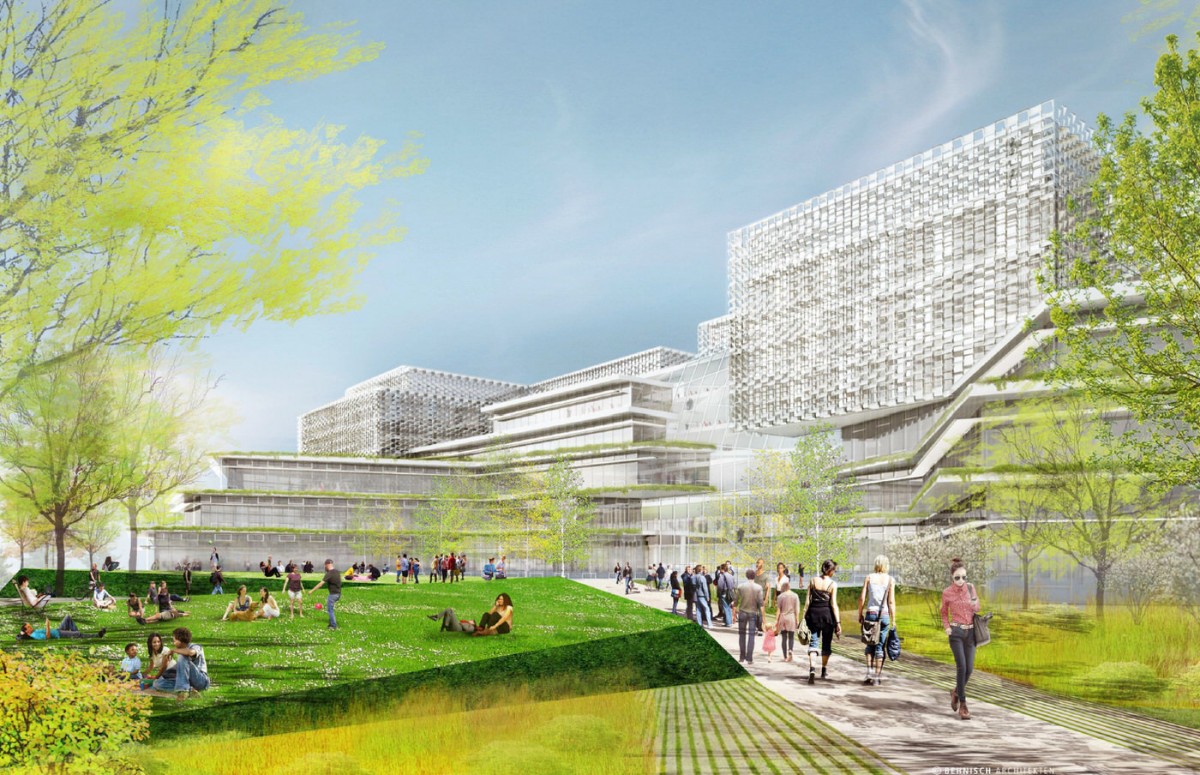
A south courtyard view of the complex. The outdoor lawn will be open to the public.
Rendering by Behnisch Architekten
Casey stressed the importance of the innovative science that will happen within the SEC, using examples of SEAS projects such as “robobees” and human organs-on-chips to illustrate the work that Harvard hopes will have “major ripples beyond 500,000 square feet,” and will bring in “investors, corporations, and non-profits all collaborating to solve problems.” The building, Casey pointed out, is the hallmark of Harvard entering a phase he described as “one campus, with a river running through the middle of it.”
The building is planned to foster “cross-disciplinary innovation within the school and across the University,” Casey said, citing the importance of SEAS collaboration with HBS, the i-lab, and the newly approved “Life Lab,” a 15,000-square-foot-building that will include 36 lab benches, tissue culture and microscopy facilities, a private faculty-in-residence lab suite, conference rooms, and collaborative work space for entrepreneurs.
“This building will anchor an innovation area that will lead to the development of an enterprise research campus, combining science and engineering innovation with business expertise,” Casey said. “We want it to be something similar to Kendall Square.” (Casey also added that the building will create roughly 800 construction jobs and about $25 million in community benefits.)
The complex—to be built on part of the foundation left behind in 2010 when construction was halted on a four-building science complex on Western Avenue—will be about 130 feet high. One-third of the interior space will be devoted to laboratories; the remainder will house classrooms, active learning labs, outdoor and rooftop patios, a café, an exhibition space, and a large atrium that will become “the heart of the SEAS community,” according to Robert Matthew Noblett of Behnisch Architekten—the firm responsible for designing the building.
According to SEAS dean Francis J. Doyle III, the allocation of space within the SEC will be:
- 35 percent research space (dedicated & shared)
- 25 percent teaching space
- 11 percent Wyss Institute for Biologically Inspired Engineering
- 10 percent community space
- 7 percent administration
- 6 percent innovation space
- 5 percent building support
“Receiving this approval for the Science and Engineering Complex represents an exciting milestone for Harvard and for SEAS,” Doyle said in a press release. “We are one step closer to the day when our faculty, students and researchers will occupy one of the world’s most advanced academic science and engineering facilities. We look forward to SEAS becoming an important anchor to the region’s newest cluster of innovation and discovery.”
Eventually, Doyle said, the vision for 2025 and beyond includes:
- Harvard’s new Gateway building will be constructed, housing other Faculty of Arts and Sciences academic units;
- Commercial development in and around Barry’s Corner will bring retail stores, restaurants, housing, and a hotel/conference center;
- A new Greenway will be created between the SEAS building and the Charles River;
- The enterprise research campus will be populated by startups and R&D units of established firms (a leader was just appointed to direct the effort);
- A new inter-modal public transportation station will open after the Mass Turnpike is straightened out, connecting the district to Kendall Square.
BRA project manager Gerald Autler called it an “exciting night,” and the culmination of a 10-year process for the Allston community task force that went through many economic ups and downs, specifically the financial crisis of 2008. Autler called the SEC a “major building block for economic development,” highlighting the $25-million public and community benefits package Harvard plans to implement, as well as the retail shops and businesses that will be associated with the new building.
“The Science and Engineering Complex is a state-of-the-art facility that will enhance partnership across academic disciplines and encourage connections among the University, the community, and new partners in industry and research,” President Drew Faust said in the press release. “The growth of our campus in Allston is an extraordinarily exciting opportunity in the Greater Boston region for collaboration, discovery, and innovation.”
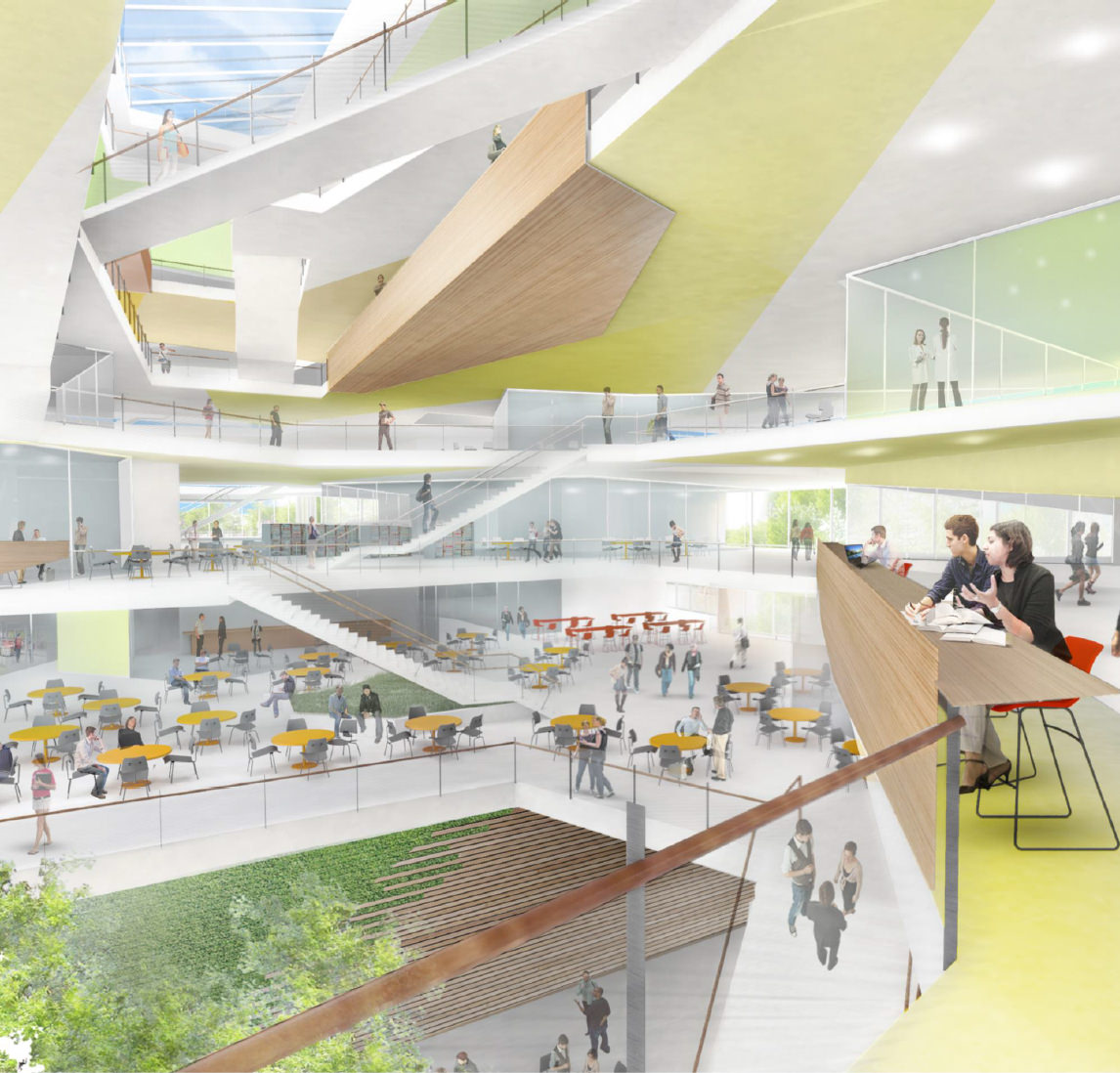
A view of the atrium from the basement level of the complex.
Rendering by Behnisch Architekten
With approvals in hand, Harvard’s fundraisers can redouble their efforts to secure funding for the project, a high priority for The Harvard Campaign.
The BRA also approved plans to renovate the Soldiers Field Park housing complex, on the eastern edge of the HBS campus, to modernize the graduate-student apartments. Work is expected to begin in June and conclude in 2020; the BRA indicated that the project would cost $183.5 million.