
Six years ago, at the class of 1961's thirty-fifth reunion, Phil Carl sang a few songs during the cabaret-style festivities. Classmate Dan Klein was so impressed by the clever lyrics that he suggested they collaborate on a project. "He's a fabulous lyricist," Klein says, "even if he did go into biochemistry or whatever." (Carl, a molecular biologist, shrugs and replies, "We all make mistakes.") They began to develop a full-length musical based on the reunion of a college class: with Klein providing the book, Carl penning lyrics, and classmate Stephen Price '61 composing the music. "My wife said that was the worst idea for a musical she'd ever heard," Carl recalls, "so I knew that I was on to something."
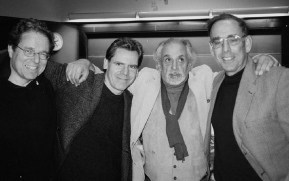 |
 Their director, Jerry Bisantz (second from left), with co-conspirators (from left) Price, Klein, and Carl. Their director, Jerry Bisantz (second from left), with co-conspirators (from left) Price, Klein, and Carl. |
The trio first worked together as undergraduates, producing a show about the space program, called Countdown. This time, their idea was drawn from the reunion "Red Books," showcasing the discrepancy between the image people present and the reality of their lives. "That's almost gone from the play now," Carl admits. "We really wanted to write about friendship. It's about all the things you can't learn at Harvard--we couldn't have written this show when we were graduating."
The trio contacted the class officers and suggested that the fortieth reunion include a performance of the work. "For the twenty-fifth, they hired the Boston Symphony Orchestra," Carl jokes, "but we were a lot cheaper." The staged reading of Reunion on October 27 in Harvard's Science Center featured local actors and an appreciative audience who seemed to understand exactly what their classmates were trying to say.
Composed mainly of musical numbers with witty and intricate lyrics, the show tells the story of five former suitemates meeting at their twenty-fifth reunion, and doesn't shy away from tough issues. The songs cover nearly all aspects of undergraduate life, including freshman fears that the admissions committee has made a mistake, fine points of Harvard vocabulary ("Coop," not "co-op," and "The Game"), and class conflict between "the kid from Brooklyn" and his eighth-generation legacy roommate. "We were all public-school kids," Price says, "and some people in the audience were surprised" at how directly the show tackled that "well-kept Harvard secret": one song, "Better Bed," deals with who's going to get the lower bunk.
The songs generating the warmest audience response, however, were those poking fun at post-graduation issues. In "He's Ahead," for instance, reunioners fret that classmates are "ahead" because of a happy marriage or a successful career. As the musical progresses, the truth about the characters is revealed: each has struggled with health, marriage, or the death of a loved one. "Every one of us has taken some painful knocks," one character says. "It comes with just living."
Reunion refuses to wallow in self-pity. "There's a happy ending," Klein says reassuringly. "The boy gets the girl. And a boy gets the boy." Ultimately, the show is hopeful. "The past is gone, we're moving on," says the final number, and that note runs throughout the musical. "Many of our classmates have survived the death of kids, friends, spouses," Carl says. "But people go on, and people need to hear that now and then."
~Celeste Ng





