Nettie Naumburg died in 1930 and left to Harvard Rembrandt's Portrait of an Old Man, a Franz Hals, a Rubens, a Holy Family by Murillo, a small El Greco, and about 15 other paintings, as well as sculptures, furniture, pottery, Oriental rugs, Renaissance needlework, carved jade, Chinese bronze bowls, a Flemish tapestry, her Manhattan living room with troubador balcony, her dining room, her several stained glass windows, her entrance hall, $100,000 to build a wing onto the Fogg Art Museum to house these things, and money to look after them.
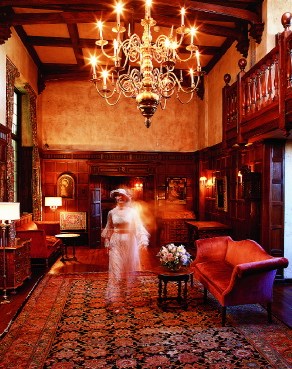 |
| The great hall as it is today |
| Photograph by Jim Harrison |
Aaron and Nettie Naumburg had one of the great New York apartmentsa 14-room, 6,000-square-foot, triplex, custom built for them in 1916 in the Hotel des Artistes at 1 West 67th Street. Its main room was 45 feet long and 16 wide and had an 18-foot ceiling. The paneling and ceilings of all the rooms on the first floor were Jacobean English, brought from England by the Naumburgs, along with Tudor arches and Gothic mantles.
Aaron Naumburgborn in Pittsburgh in 1859, the son of a rabbiwas a producer of hatters' furs and a philanthropist. He died in 1928. The Naumburgs had rejoiced in their New York digs and hated to think of them erased. And so the Aaron and Nettie G. Naumburg Rooms came to Cambridgecontents, paneling, ceilings, and all. The museum could remove items (and it did) or rearrange them as long as the essential character of the rooms was preserved. Mrs. Naumburg meant the rooms to be used for receptions, for musicales, for talks, and as a commons for museum staff. The public may see the objects on display by appointment, and one may engage the rooms for one's own gala after museum hours for a not-insubstantial fee.
At the dedication of the installation, on November 9, 1932, a Naumburg kinsman said with feeling, "This room and all its contents, its very walls, have now, by a magic carpet, been transported to this placeto this shelter from the alarms of a dark and frightened world, this great College, this island of youth."