
Amid what administrators and police said was the heaviest security ever for a Harvard speaker, Pervez Musharraf, president of Pakistan, told a packed audience at the Kennedy School of Government that the war on terrorism must reach deep to address the root causes of terror. Speaking at the first Institute of Politics Forum of the year on September 8a day after most freshmen moved in and three days before the observance of September 11 (see page 51)Musharraf presented his vision for Pakistan and addressed what he said he considers the biggest problems facing his nation in the years aheadreligious extremism and poor relations with India (which he said are at their "lowest ebb" in years).
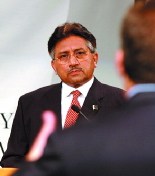 |
| President Pervez Musharraf |
| Justin Ide / Harvard News Office |
Musharraf, an army general, has been the self-proclaimed president of Pakistan since June 20, 2001, and the country's chief executive since seizing power in a bloodless coup in October 1999. Since then, he has implemented some political reformsincluding popular elections at the local and provincial level and the setting aside of one-third of all local government posts for womenwhile also trying to rebuild Pakistan's physical and educational infrastructure. He explained in his speech that the "remarkably hopeful moment" of Pakistan's founding in August 1947 quickly gave way to abuses of the democratic system in the 1970s, '80s, and '90s. "We lost our way," he said. Now he sees his challenge as building a "modern, moderate, tolerant and a progressive, democratic Islamic state." His work comes at a moment when Pakistan's role on the world stage is larger than ever before.
Historically shunned by the West for his government's support of the Taliban in Afghanistan, Musharraf found himself a key U.S. ally after he agreed to support the war on terrorism. He has been a vocal critic of religious extremism ever since, declaring in his speech that he was "determined not to allow a fringe element to hold [Pakistan] hostage and hijack our agenda for reforms." He told the audience that the war on terrorism must address the religious fanaticism that led to Osama bin Laden's rise: "Hate should have no market. It must be stamped out with the same zeal with which the fight against terrorism is being pursued....We must diagnose the malaise and treat the root causes of terrorism. What is it that conjures up such storms in the minds of individuals? What motivates a suicide bomber that his instinct for survival is overcome by a death wish?"
During a question-and-answer session after the speech, one exchange highlighted the uphill battle facing Musharraf as he pursues his reform agenda. When a student asked what hea young, educated Pakistani living abroadcould do to help his homeland, Musharraf began, "It is often said that our generation has failed Pakistan," to which the student quickly replied, "That's true." Amid audience laughter, Musharraf pounded the lectern and asserted, "But I hasten to add that I'm not failing Pakistan!"





