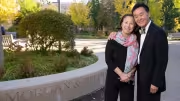
Harvard Names Open Access Architect Director of New Office for Scholarly Publishing

The OSC will be responsible for implementing University policies on open access. Read more about Shieber's appointment...

Stuart M. Shieber '81, Welch professor of computer science, who led the Faculty of Arts and Sciences in its historic adoption of an open access policy—designed to make the articles its members publish in scholarl journals freely available on the Internet—has been named director of the University's new Office for Scholarly Communication (OSC). The OSC will be responsible for implementing University policies on open access.

Read more about Shieber's appointment here.

Related topics

You might also like

The division is launching a new fundraising effort to support 50 additional students.

President Alan M. Garber used traditional Memorial Church address to consider the unique qualities of human intelligence and learning.

Due to rain, the University held dual Convocation ceremonies for the Class of 2030 in Sanders Theatre.

Most popular

Harvard art historian Jennifer Roberts teaches the value of immersive attention

Teaching students the value of deceleration and immersive attention

The University will compensate families of those whose remains were sold and establish a scholarship to honor anatomical donors.

The 1884 Cannibalism-at-Sea Case That Still Has Harvard Talking

The Queen v. Dudley and Stephens changed the course of legal history. Here’s why it’s been fodder for countless classroom debates.

Explore More From Current Issue

A woman with curly blonde hair sits casually against a stone wall, wearing a black top and jeans.

Chloe Chapin trains her Broadway costume designer’s eye on the history of men’s fashion.

Two laboratory researchers, one seated and one standing, in a scientific lab with equipment.

The stakes are high for this husband and wife: one of them will die if they don’t find a cure.

A flooded office scene with computers, a woman working, and a pink sunset backdrop.

A College student’s attempt to recapture the romanticism of the workplace.