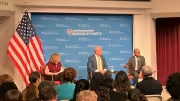
During the regularly scheduled Faculty of Arts and Sciences (FAS) meeting on December 15, President Drew Faust took the opportunity to comment on the activities of the Harvard Corporation (as the seven-person President and Fellows of Harvard College, the University’s senior governing board, is commonly known).
Her point of departure was the decision of senior fellow James R. Houghton '58, M.B.A. '62, to step down from the Corporation at the end of the academic year--a decision shared with the Corporation on December 7, according to the official announcement made on December 14--and the search for his successor. He is to be succeeded as senior fellow by Robert D. Reischauer '63, who has been a Corporation member since 2002, and was an elected Board of Overseers member for the six years before that.
Beyond that news, however, Faust told the faculty members present that at each of its recent meetings during the fall, the Corporation had discussed how it could most effectively carry out its roles and responsibilities—a discussion she said had been led by Houghton. Faust said that he and she felt it was important for the Corporation to take a close look at how it did its work as a board and what practices would be most sensible: the sort of review that any such entity ought to make of its operations from time to time, and that the Corporation ought especially to take at the present time, in light of changes in the University itself and in the larger world. She described this set of activities as a time of reflection for the Corporation. Given that the Corporation rarely, if ever, discloses anything about itself or its work, and rarely is a subject of FAS discussion, Faust's remarks were unusual.
Among the matters Faust said had been specifically raised were:
• how the Corporation sets its agendas and spends its time during its regular meetings;
• how it receives information and interacts with key University constituencies;
• how it relates to the Harvard administration and the Board of Overseers (the larger, junior governing board; it meets less frequently than the Corporation and formally assents to some of the senior board's important decisions, such as the appointment of a new president); and
• how, generally, the Corporation benefits from advice available to or offered to it.
Faust invited faculty members to offer such advice (in person, by letter, or via e-mail to ogb@harvard.edu), as part of the Corporation’s intention to consult widely.
The Corporation is unusual among modern institutional boards: it is self-renewing, and although there are informal standards for how long members serve, appointment is not for a set term. It has not, as a practice, made efforts to communicate about its concerns or deliberations, or to convey information about its decisions on matters of policy, budgets, or other major issues.
In 2006, Harvard Magazine published "Governing Harvard," a roundtable conversation on the University’s governance and the distinctive characteristics of the Corporation, featuring two past Corporation members (one, Henry Rosovsky, a past FAS dean, now serves as president of the magazine’s board of directors) and two faculty members with expertise on boards of directors, institutional governance, and governance of higher-education institutions. They made some suggestions for how the Corporation might, at a minimum, communicate more openly with the community.
The weekend before the FAS meeting, professors Harry Lewis (a former Harvard College dean) and Fred Abernathy published a sharp critique of the Corporation’s performance as an op-ed in the Boston Globe (“Shrouded in secrecy, decision makers gambled and Harvard lost”). They focused on Harvard’s recent severe endowment losses and other financial losses, and the decisions concerning spending, fundraising, and increasing reliance on distributions from the endowment that were made earlier in the decade. Their conclusion: “The Harvard Corporation is a dangerous anachronism. It failed its most basic fiduciary and moral responsibilities. Some of its members should resign. But the Corporation’s problems are also structural. It is too small, too closed, and too secretive to be intensely self-critical, as any responsible board must be. Until the board can be restructured, the fellows should voluntarily share their power with the overseers. And Harvard should reveal the risks of its business plans, as would be required if it were a publicly held corporation. That exercise in transparency would surely serve Harvard well.”
In light of the financial pressures facing the University and FAS in particular, discussion has arisen about how budgets were made and spending priorities set--and about the Corporation's work. Some of these issues bubbled up in an October 16 Harvard news office interview with Corporation member and treasurer James Rothenberg and subsequent reporting on the University's financial losses by the Globe's Beth Healy--all summarized here. In a late November dispatch, Healy reported that the Board of Overseers were not told about Harvard's swap and general operating account losses during fiscal year 2009--totalling at least $2.3 billion, and potentially as much as nearly $3 billion--until shortly before the news was released to the public in mid October.
The Crimson's detailed coverage of Houghton's announcement, by Esther Yi, may be the clearest indication of change: it quotes comments from an unprecedented three Corporation members: Nannerl Keohane (president emerita of Wellesley and of Duke), in an e-mail; Robert Rubin, who joined the Corporation shortly before Reischauer in 2002, but who is not being tapped as senior fellow, also in an e-mail; and Reischauer himself, in an interview.
Any such change, it is clear, would emanate from within the Corporation itself, but the stirrings this week suggest that some new norms for outreach and communication, at least, are being tested.