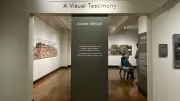
Image gallery: homeless artists respond to stereotypes

Paintings by homeless artists in New Jersey respond to the social perception of homeless people as cold and incompetent.

<i>I See a Brighter Day</i>
<i>How You See Me</i>
<i>Pulling My Way Out!!!!</i>

Ruthann Traylor learned of research on stereotypes by Amy Cuddy, a social psychologist at Harvard Business School, years ago when they were neighbors. (Cuddy was then studying for her doctorate at Princeton.) “I read the section on how the poor and homeless were perceived to 12 poor and homeless women at the shelter,”  says Traylor, who is now the director of ArtSpace, a homeless shelter in West Trenton, New Jersey, run by HomeFront, a nonprofit social service agency. “We spent a year and a half responding to this perception by collecting poems and art work by the people I work with.” In April 2010, an exhibition of this work opened at Princeton’s Woodrow Wilson School for Public and International Affairs, with a panel discussion two weeks afterward featuring Cuddy and fellow psychologists Susan Fiske and Peter Glick; 200 attended, and the exhibition ran into August.

In the gallery here, see some examples of paintings by these homeless artists, made in response to the research that showed the homeless were generally perceived as both cold and incompetent.


Related topics

You might also like

How a Harvard Hockey Legend Became a Needlepoint Artist

Joe Bertagna’s retirement project recreates figures from Boston sports history.

These Harvard Mountaineers Braved Denali’s Wall of Ice

John Graham’s Denali Diary documents a dangerous and historic climb.

This TikTok Artist Combines Monsters and Mental Heath

Ava Jinying Salzman’s artwork helps people process difficult feelings.

Most popular

Martin Nowak Placed on Leave a Second Time

Further links to Jeffrey Epstein surface in newly released files

Why Men Are Falling Behind in Education, Employment, and Health

Can new approaches to education address a growing gender gap?

Explore More From Current Issue

Graduates celebrate joyfully, wearing caps and gowns, with some waving and smiling.

Inside Harvard’s Most Egalitarian School

The Extension School is open to everyone. Expect to work—hard.

Illustration of a person sitting on a large cresting wave, writing, with a sunset and ocean waves in vibrant colors.

How Stories Help Us Cope with Climate Change

The growing genre of climate fiction offers a way to process reality—and our anxieties.

Modern building surrounded by greenery and a walking path under a blue sky.

A New Landscape Emerges in Allston

The innovative greenery at Harvard’s Science and Engineering Complex