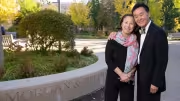
For telling the long-overlooked story of Alex Dumas, the French Revolutionary soldier whose exploits and fate inspired his novelist son, Tom Reiss ’86 today received the 2013 Pulitzer Prize for Biography or Autobiography. The Pulitzer committee called The Black Count: Glory, Revolution, Betrayal, and the Real Count of Monte Cristo (Crown) “a compelling story of a forgotten swashbuckling hero of mixed race whose bold exploits were captured by his son, Alexander Dumas, in famous 19th century novels.” (For a taste of the book, read Reiss’s Vita of General Dumas from this magazine’s November-December 2012 issue.) The book was previously a finalist for the National Book Critics Circle Award. Reiss’s earlier biography, The Orientalist, the story of Lev Nussimbaum, “a Jew who transformed himself into a Muslim prince and became a best-selling author in Nazi Germany”—became an international bestseller.
Three alumni also numbered among the finalists for this year’s prizes:
- Adams University Professor emeritus Bernard Bailyn, Ph.D. ’53, LL.D. ’99, for History, for The Barbarous Years: The Peopling of British North America: The Conflict of Civilizations, 1600-1675 (Knopf), a “luminous account of how the British colonies took root amid raw brutality, often with terrible consequences for the settlers as well as the native population.” (Read a review from our archives here.)
- Juliette Kayyem ’91, J.D. ’95, of The Boston Globe, and a lecturer in public policy at Harvard Kennedy School, for Commentary, “for her colorful, well-reported columns on an array of issues, from women in combat to oil drilling in Alaska.”
- Patricia Wen ’80, of The Boston Globe, for National Reporting, as one of five Globe reporters honored for “their aggressive coverage of the deadly national outbreak of fungal meningitis traced to a compounding pharmacy in suburban Boston, revealing how the medical regulatory system failed to safeguard patients.”