Three alumni—James V. Baker ’68, M.B.A. ’71, William Thaddeus Coleman Jr., J.D. ’43, LL.D. ’96, and Georgene Botyos Herschbach, Ph.D. ’69—were scheduled to receive the 2013 Harvard Medal for outstanding service to the University on May 30th during the HAA’s annual meeting on the afternoon of Commencement day. Although illness prevented Coleman from attending the event, his daughter was present; President Drew Faust said that the award would be given at a later date before reading his citation aloud, along with the others.
Baker is the first international alumnus to have served as president of the HAA (see “‘Pure Brit’ Finds Second Home at Harvard” from this magazine’s September-October 2003 issue). He had previously served as president of the Harvard Club of the United Kingdom, and in 2000 received an HAA Alumni Award for the diverse ways he has helped Harvard since starting out as an alumni interviewer in 1972. As HAA regional director for Europe, he organized a leadership conference for continental Harvard clubs that was so successful it became a model for other Harvard clubs overseas. Baker, a longtime employee of Goldman Sachs, retired as executive director of its equities division in 1996.
President of the Harvard Alumni Association and President of the Harvard Club of the United Kingdom, First Marshal of the Class of 1968 and student athlete extraordinaire, you have served Harvard as a loyal leader and outstanding organizer, strengthening Harvard’s relationship with its international alumni.
Coleman, who ranked first in his law-school class, became the first African American to serve as a clerk for a U.S. Supreme Court justice. He was also a contributing author to the 1954 case Brown v. Board of Education and later became president of the NAACP Legal Defense Fund. For Harvard, he served as Overseer from 1975 to 1981 and has been a member of five Overseer visiting committees, as well as a member of the Harvard Law School (HLS) Dean’s Advisory Board (a post he has held since 1997). Coleman has received numerous past awards for his work—the Harvard Business School Distinguished Service Award, the HLSA Award, and the Harvard Club of Washington, D.C., Public Service Award—and has been an HLS Traphagen Speaker.
Harvard Overseer, distinguished American, and devoted alumnus of the Harvard Law School, you have always upheld the highest standards for law and public service in our community and country, leading by exhortation and example as a visionary advocate for civility and civil rights.
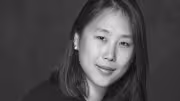
Herschbach earned her doctorate in chemistry and went on to help expand Harvard’s life-sciences programs and co-found the Program for Research in Science and Engineering, which provides summer research experiences for undergraduates in the natural and applied sciences. She has held numerous College posts, such as associate dean of academic programs, associate dean of administration and finance, dean of administration, and also served as registrar for the Faculty of Arts and Sciences. In addition, she and her husband, Nobel Prize winner and Baird professor of science emeritus Dudley R. Herschbach, were co-masters of Currier House from 1981 to 1986.
Exemplary Harvard citizen holding countless administrative roles in the College, including Registrar, Dean of Administration, and co-master of Currier House, you have served with excellence and selfless devotion, helping to improve the education and life experiences of students, faculty, and staff.