Renovated Harvard Art Museums to open November 16 2014

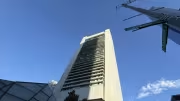
The new Renzo Piano-designed facility will open to the public on November 16, 2014.

The façade of the new 204,000-square-foot Renzo Piano-designed facility rises from the back of 32 Quincy Street.

The façade of the new 204,000-square-foot Renzo Piano-designed facility rises from the back of 32 Quincy Street. | Aerial photograph by lesvants.com/courtesy of the Harvard Art Museums

Lit at dusk, as seen from Prescott Street

Lit at dusk, as seen from Prescott Street | Photograph by the Harvard Art Museums

On the first, second, and third levels, the new building adds more than 12,000 square feet of new gallery space—bringing the total to 43,000 square feet—some designed specifically for instructional use.

On the first, second, and third levels, the new building adds more than 12,000 square feet of new gallery space—bringing the total to 43,000 square feet—some designed specifically for instructional use. | Photograph by Zak Jensen/courtesy of the Harvard Art Museums

Natural light streams in from a glass roof above the fifth level.

Natural light streams in from a glass roof above the fifth level. | Photograph by Pete Vanderwalker/courtesy of the Harvard Art Museums

University officials announced today that the Harvard Art Museums will open their new 204,000-square-foot Renzo Piano-designed facility (as seen in this preview of the new building) to the public on November 16, 2014. The $350 million renovation and expansion will bring together the Fogg Museum, the Busch-Reisinger Museum, and the Arthur M. Sackler Museum under one roof for the first time at 32 Quincy Street, allowing students, faculty, scholars, and the public access to the museum’s acclaimed collections. The space, officials said, is designed specifically to create places for close engagement with individual works of art for both the Harvard community and the general public. A café and a museum shop will flank the courtyard on the first floor, and the public will be able to visit both without an admission fee.

 “We knew that we had an opportunity to redefine the Harvard Art Museums as an accessible and connected 21st-century facility for teaching and learning, so we engaged Renzo Piano to design a building to implement that vision,” said Cabot Director of the Harvard Art Museums Thomas W. Lentz. “We also wanted to strengthen the museums’ role as an integral part of Cambridge and Boston’s cultural ecosystem.”

The opening will include a series of events, beginning with a celebration for Harvard students. Special events—unspecified at this time—for faculty, donors, museum supporters, alumni, and others will follow, culminating in a preview for Cambridge residents ahead of the public opening on November 16.

Read the art museums' announcement here.
 

You might also like

Harvard Graduate Student Union Authorizes Another Strike

The University warns this walkout may not be protected by labor law, an assertion the union disputes.

FAS Readies for Administrative Transition

Faculty leaders say layoffs will yield $20 million in annual savings.

Trump Administration Asks Appeals Court to Restore Harvard Funding Cuts

The government’s lawyers homed in on a jurisdictional argument for its authority to to terminate federal grants. 

Most popular

Harvard Alumni Win Two 2026 Nobel Prizes

Karl Deisseroth revolutionized neuroscience. Navanethem “Navi” Pillay has adjudicated cases in international courts concerning genocide.

Lafayette’s Unexpected Gift to George Washington: Pheasants

The two birds will be on display at Harvard this summer.

Harvard Weathers a Year of Turmoil

The federal government has launched unprecedented actions against the University. Here’s a guide.

Explore More From Current Issue

Caricature of a young man in front of red doors, wearing a green striped sweater.

In 1954, Gregory Corso moved into Eliot House. How he stayed there is a literary legend.

A busy classroom filled with students working at computers, colorful decor, and a bright atmosphere.

In 2004, a frenzy spread across Harvard Yard in days. Four billion users later, we are only just catching up.

A glowing bulb shape surrounded by colorful, swirling energy lines against a blue background.

Harvard researchers achieve medical breakthroughs in cancer therapy and infection control.