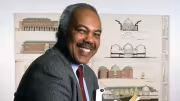
Kenneth C. Griffin ’89, founder and chief executive officer of the Citadel LLC, a multibillion-dollar, Chicago-based hedge-fund and financial-services enterprise, has given Harvard $150 million, principally for undergraduate financial aid, the University announced in February. That large gift, and others, helped The Harvard Campaign and its Faculty of Arts and Sciences (FAS) component achieve significant progress toward their overall goals in the months since their public launch announcements last autumn (see below).
In making his gift, the largest in College history, Griffin called it
extremely important that students of all backgrounds have the opportunity to challenge themselves, learn to solve complex problems, and ultimately better our world. My goal with this gift is to help ensure that Harvard’s need-blind admission policy continues, and that our nation’s best and brightest have continued access to this outstanding institution.
The gift:
- establishes 200 Griffin Scholarships (such financial-aid endowment scholarships are now available for donations of $250,000 each; that minimum is to rise to $500,000 in the fiscal year beginning July 1); and
- provides matching funds through the new Griffin Leadership Challenge Fund for Financial Aid for 600 new scholarships to encourage other donors to make commitments to the College’s financial-aid program.
Depending on the matching formula and timing of gifts, the Griffin Scholarships, other donors’ gifts (when received), and the matching funds provided by Griffin could collectively generate a significant portion of the Faculty of Arts and Sciences’ (FAS) $600-million capital-campaign goal for undergraduate aid. (The only equivalently large FAS priority is its $600-million faculty-related target for endowed chairs, graduate-student fellowships, research support, and related purposes.) In acknowledgment, the College financial-aid office will be renamed the Griffin Financial Aid Office, led by the Griffin director of financial aid.
Griffin’s gift also includes $10 million to establish the Griffin professorship of business administration at Harvard Business School (from which his wife, Anne Dias Griffin, who runs a separate hedge fund, earned her M.B.A. in 1997).
FAS dean Michael D. Smith declared himself “absolutely bowled over by the generosity of Ken Griffin and his leadership to provide a truly transformational gift” for the top College priority in the capital campaign. During an interview last autumn, before the campaign launch, Smith said the aid budget had “never been put on the table” in the aftermath of the 2008-2009 financial crisis—even as the faculty’s assets decreased by $5 billion and family need rose during the ensuing recession. But, as he said in an interview concerning Griffin’s gift, he has worried continuously about “truly making our program sustainable,” even at its current scale. In the statement announcing the gift, Smith declared that Griffin’s philanthropic leadership “has set financial aid…on a lasting foundation,” and his gift “will impact the lives of students and their families, now and for generations to come.” For a complete report on the gift and its implications for FAS, see https://harvardmagazine.com/2014/02/an-unprecedented-gift-for-undergraduate-financial-aid.
In other campaign-related news, the University disclosed that The Harvard Campaign has secured gifts and pledges of $900 million since last September, when it was launched with $2.8 billion in hand; that brings the proceeds to 57 percent of the $6.5-billion goal. And in a March 31 message to his faculty colleagues, Dean Michael D. Smith revealed that the $2.5-billion FAS campaign, unveiled in late October with $1.0 billion of gifts and pledges secured, had by the end of February raised an additional $300 million of commitments, bringing the fundraising drive to 52 percent of its target; he highlighted progress on priorities including funding faculty positions and scholarly initiatives, House renewal and other aspects of student life, and of course undergraduate financial aid. For a detailed report, see https://harvardmagazine.com/2014/03/harvard-campaign-at-3-7-billion. Harvard Divinity School launched its campaign as this issue went to press; click here for additional information.