Traditionally, Harvard has not been known as a golf power. The school’s most significant figure in the sport (if you don’t count Bobby Jones ’24, who didn’t tee it up for the Crimson) arguably is Edward S. Stimpson II ’27, two-time captain of the golf team, who in 1935 invented the Stimpmeter, a device now widely used to measure the speed at which the ball rolls on the greens. But in the last few seasons, under Fred Schernecker ’89, the Weissman director of golf, and coach Kevin Rhoads, Harvard’s linksters have been on a roll of their own. Last season the men’s team captured its first Ivy title since 1975. That group is a bunch of duffers compared to the women, who have won five Ivy championships in a row. The mainstay of the last three titles has been steely Anne Cheng ’17. She has been voted team captain for 2016-17 and will attempt to become the second Harvard player (after Emily Balmert ’10) to be a four-time first-team All-Ivy selection.
Growing up in Torrance, California, Cheng became attracted to the sport watching its two dominant players, Tiger Woods and Annika Sorenstam. “Tiger was the man,” Cheng says. At nine, she began competing in local tournaments, then made a name for herself on the rough-and-tumble junior golf circuit. She was heavily recruited and briefly contemplated a pro career. Her swing coach in California, Don Brown, who believes she could have held her own on the LPGA tour and certainly would have been a force in big-time collegiate golf, says she “could have gone anywhere in the country—UCLA, Stanford, anywhere.” (He steeped his pupil in the moves of Ben Hogan, one of the sport’s iconic ball-strikers.) But Cheng chose Harvard “because of all the other things I liked to do, and I didn’t know if I wanted to dedicate myself full-time to golf.”
The hallmark of her game is consistency. In all three of her seasons in Cambridge, Cheng has had the team’s lowest scoring average; for her 24 rounds in 2015-16, it was 75.42 strokes. Her numbers generally stay in the low and mid 70s, no mean feat when weather and course conditions often limit practice time. Rhoads, last season’s Ivy League men’s and women’s coach of the year, marvels at her technical soundness. “She has a super-solid game that is foundationally extremely correct,” he says. “Her [swing] angles are fantastic. Her flow and her dynamics and sequence are also gorgeous to look at. Her putting is super-solid and her short game is solid. All those add up to the lowest scoring averages we’ve ever had.” Cheng is not particularly long off the tee; a typical drive goes perhaps 230 to 240 yards. (“Pretty far for her size,” says Rhoads of Cheng, who weighs 150.) But the ball invariably flies dead straight—right down the sprinkler line, in links parlance, just like the drives of her female role model, Sorenstam.
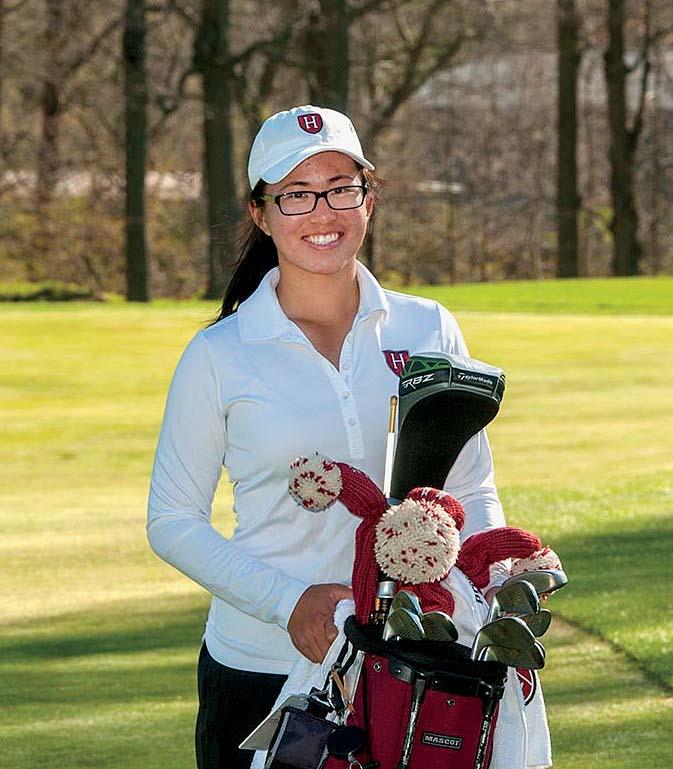
Anne Cheng
Photograph by Jim Harrison
The best club in Cheng’s bag, though, might be one that no one sees: her mind. In a frustrating game that drives even the best players bonkers, her even disposition stands out. “I know what’s realistic for a given shot and what’s not, and what I should be happy with in a given situation, so I’m very calm and even and flat even if I shank a ball into the parking lot,” she says. Her humble mien also masks a fierce competitiveness; Brown labels her “the quiet assassin.”
That mind-set allows Cheng to pull off shots that others can’t. Rhoads witnessed one such virtuoso effort at Brown during her freshman season. “There was a 205-yard par 3,” he says. “In front of the green was a massive, 20-yard-deep swale, and over the back was out of bounds. There was a hard left-to-right wind. Everyone was coming up short in the big dip. Anne hit a three-wood through the wind, right onto the green, to 20 feet of the pin. That was business as usual for her. Her intuition of how to control ball flight is unteachable, intangible.”
Cheng’s most recent stroke of genius came last season on the final hole during the second day of last spring’s NCAA regionals, at the University Club in Baton Rouge, Louisiana. “I hit a not-so-perfect drive down the right side of the fairway to leave myself with a little more than 200 yards onto the green of the par four,” she recalls. “The pin was tucked in the back corner, and the green was guarded by a bunker and a dip off to the right side. That day my woods had been a bit inconsistent, so my confidence had faltered when I saw that I had left myself with such a long shot. But I remember looking at the green in the distance and then looking at my teammates standing behind the hole waiting for my group to come up. I had a momentary rush of inspiration. I was pumped to have the shot in front of me, and I didn’t want to let the team down. The few seconds of confidence, focus, and commitment I had as I stood over the ball was all that was needed for me to hit a shot I was proud of. It flew straight for the pin and ultimately ended up around 15 feet from the hole. I don’t think I hit a shot that solidly all season.” She went on to two-putt for a par and finish with a very fine 74. (The Crimson ended tied for ninth in the 18-team field, from which the top five schools advanced to the NCAA finals.)
The concern for the squad that Cheng displayed as she contemplated that shot also delights Rhoads. “She’s the most selfless teammate we’ve ever had,” he says. “It’s never about her. She’s always up and trying to figure out what she can do to help other people. And then she can really play. The combination sets a standard.”
When Cheng arrived in Cambridge, she planned to be an economics concentrator. But during her sophomore year she switched to neurobiology and now aims at medical school. Accordingly, this past summer she largely forsook the driving range for an internship in the neurology department at Massachusetts General Hospital. She admits that she “gets excited” when she reads of a professional victory by one of the ladies she played against on the junior circuit. But she does not ponder the cartpath not taken. Instead, captain Cheng is focused on the task at hand: “Keep the team on the right track and hopefully results will come in the end.”