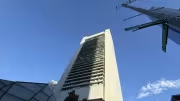
Editor’s note: Henry Cobb ’47, M.Arch. ’49, a former professor and chair of the architecture department at the Graduate School of Design, whose work includes Harvard’s Center for Government and International Studies (CGIS) complex, died on March 2. Susan Pharr, Reischauer professor of Japanese politics, a subsequent resident of that complex, has shared with us a recollection of Cobb, and we are pleased to be able to share it with readers.
I vividly recall attending the various sessions on the Harvard campus in the late 1990s at which the plans for the new complex that was to house the Government Department and the international and regional centers were discussed. And I was there at showtime, the big meeting in the Barker Center where the three architects, the finalists, went head-to-head before a very large audience of faculty and administrators. Harry Cobb easily bested his competitors. He came across as smart, witty, down-to-earth, and as someone who understood what the buildings’ occupants would care about. His competitors, one of them the famous Japanese architect Fumihiko Maki, failed to connect; the third presenter, from a firm whose name I have forgotten, told us that Cambridge was overcrowded, that social responsibility dictated a minimal footprint for the complex, and that under his plan, faculty offices would all be below grade, which would work (he claimed) because shafts of light from a skylight would penetrate even five subterranean floors down. His presentation was met with a shocked and stony silence. Harry Cobb prevailed.
So CGIS happened, and opened in the fall of 2005 with great fanfare. And people settled in. Then one day four or five years later, I was working in my CGIS South office on a Saturday. Heading to the ladies’ room, I encountered a distinguished-looking older couple standing on the second floor landing in CGIS South, gazing up at the circular stairway to the third floor, which rises from a “pond” of shiny black stones imported from a river in China. (I know the origin because I was passing by the day the cardboard boxes of stones arrived with a return address in China.) It was totally unexpected to find someone from the public in the building on a Saturday, so I stopped and asked if they needed help, or if I could answer any questions. The man then spoke and said he was “the architect, Harry Cobb.” He asked how I liked the building and I expressed my great enthusiasm for the complex, including for the circular staircase that he and his wife had been contemplating.
I told him that I loved my office and he immediately asked to see it. So with some trepidation, I led him to S-238. He stepped inside and looked around my office intently. He said something polite, like “Very nice,” but then he hesitated and added, “Too bad you have those five-drawer file cabinets up against the glass corridor wall. The idea is that the light should be coming in through the exterior offices to brighten the corridor.” I hung my head and apologized.
And Harry Cobb left. But the problem was that I continued to hear his voice in my head, and I now saw my office through his eyes. How could I have not seen that my two hulking five-drawers did, in fact, darken the corridor? Why had I let my focus on work and the need to store my papers blind me to a public good? After a week, I could stand it no longer, and I ordered two three-drawer file cabinets. The five-drawers were hauled away. I no longer have enough space for my files, but I have the satisfaction of knowing that I no longer mar an artistic vision.