
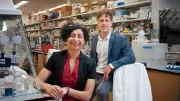
For Susan Murphy, mathematics was always the place “where everything made sense.” The first woman tenured in Harvard’s statistics department, she fell in love with numbers as a grade-schooler in southern Louisiana, surrounded by chemical plants and antebellum homes. She followed her interest to Louisiana State (“Because, you know, everybody goes to LSU if you’re from Louisiana”) and took every math course offered. In graduate school, she dove into probability and read a paper on martingale theory—“an area that studies how data evolve over time”—that changed her life. “I realized I wanted to solve real problems but use beautiful math to do it,” she says. In 2013 she won a MacArthur Fellowship for work on methodologies for finding therapies to treat chronic or relapsing diseases: depression, schizophrenia, addiction, cancer. “Much of the way we’ve collected data evidence in medicine is via randomized trials that were developed long ago, for settings in which the patient either was cured or died,” Murphy says. “So, you really only got one chance to help.” Today, as diseases wax and wane, clinicians must make a sequence of decisions about care. So, too, must patients, and Murphy’s recent work aims at them: mobile applications that use artificial intelligence to support struggles with alcoholism, smoking, overeating, and other challenges. “The contingencies of the moment conspire against you,” she says. “But a wearable device—a phone, a tracker—can help manage those contingencies with suggestions, advice, support. They can help get you to the next moment.” To clear her mind of professional puzzles (and help with her own contingencies), Murphy plays ice hockey, seriously, five times a week—another unlikely outcome for a Louisiana girl who fell, hard, for mathematics.
Susan Murphy
Portrait of a hockey-playing statistician—from Louisiana

Susan Murphy | Photograph by Jim Harrison
You might also like

Jason Furman: Capitalism Is Working. It Could Work Better.
On Open to Debate, the Harvard economist defended free market competition—with meaningful government involvement.

Two Scientists Bring the Laboratory to the Stage
The play Spare Parts is a contemporary fable about the quest to live forever.

Don’t Call Stephanie Pierce A Paleontologist
From competing in youth gymnastics to studying tetrapods, the Harvard curator has always chased her curiosity.
Most popular


Explore More From Current Issue

The stakes are high for this husband and wife: one of them will die if they don’t find a cure.

A College student’s attempt to recapture the romanticism of the workplace.

The play Spare Parts is a contemporary fable about the quest to live forever.