Headlines from Harvard’s history

Headlines from Harvard’s history

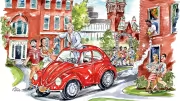
Illustration of football players hanging their laundry out to dry

Illustration by Mark Steele

1932

Herbert Hoover carries the College (1,211 votes) in the Crimson’s presidential poll. The Alumni Bulletin attributes Norman Thomas’s strong showing (484 to FDR’s 620) to “an extraordinary increase of independent thinking among the students.”

Harvard football candidates are now required to change their socks and underwear at least three times a week. Long hair and moustaches, coincidentally, are becoming passé for members of the team.

1947

President James Bryant Conant criticizes the Soviet Union for its unwillingness to agree to international control of the atomic bomb, which he characterizes as “a sword of Damocles hanging over our industrialized civilization.”

1952

Harvard begins its largest financial aid program, allocating almost $1 million in scholarships, loans, and jobs for more than one third of the undergraduate student body.

1967

Institute of Politics scholars studying the draft system recommend higher pay for draftees and enlistees, abolition of special deferments for students and teachers, and a lottery to determine “who should serve when not all serve.”

1972

The new Harvard Center for Research in Children’s Television, with administrative support from the Children’s Television workshop, will explore the effects of visual media on children.

1987

“Ambitious plans are afoot to wire the University for the information age,” the editors report. The Corporation has been asked to authorize a new network that will introduce, among other things, “state-of-the-art telephone service.”

1997

In accordance with Harvard’s non-discrimination policy, the University’s Board of Ministry recommends that same-sex blessing or commitment ceremonies be permitted in Memorial Church.

Related topics

You might also like

250 Years Ago, Harvard Was Home to a Revolution

A look at the sights, sounds, and characters that put the University on the frontlines of history

How the American Revolution Freed a Future Abolitionist

Darby Vassall, an enslaved child freed after the Battle of Bunker Hill, dedicated his life to fighting for liberty.

When the Revolution Hit Cambridge, Harvard Moved to Concord

College students broke hearts and windows during their year in exile.

Most popular

At Harvard, Mitt Romney Warns Against ‘Authoritarian’ Presidential Power

The former senator touched on polarization, tech governance, and diplomacy during a conversation at the Institute of Politics.

Martin Nowak Placed on Leave a Second Time

Further links to Jeffrey Epstein surface in newly released files.

Harvard Law Professor Explains the AI Battle Between Tech and Government

Jonathan Zittrain compares today’s conflicts to tensions surrounding the early internet.

Explore More From Current Issue

A man holding a revolver and lantern, wearing a hat and coat, appears to be walking cautiously.

Scoundrels, Then and Now

On con men, Mark Twain, and the powers of the Harvard name

Alene Anello smiling surrounded by four chickens in a natural outdoor setting.

Harvard-trained lawyer fights for the rights of chickens

Alene Anello wants to apply animal cruelty laws to birds raised for meat.

Colorful illustrated map of Colonial Cambridge and the Harvard College campus featuring buildings of the campus, houses, Cambridge Common, and the Charles River

250 Years Ago, Harvard Was Home to a Revolution

A look at the sights, sounds, and characters that put the University on the frontlines of history