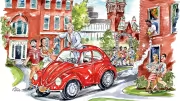
Humorous illustration of Harvard Yard with Widener Library and University Hall; between the two buildings there is a swimming pool and people enjoying the pool.

Yesterday’s News

Courses in swimming pool management and table-waiting—with an eye toward summer employment

1913

Capping a 9-0 football season—with Harvard scoring a total 215 points to their opponents’ 21—the Crimson squad achieves their first victory (15-5) over the Elis in the 10-year-old Harvard Stadium. Junior Charlie Brickley’s record five field goals play a major role (see this issue, page 36).

1923

Ninety-six women with School of Education degrees have been listed in the new Harvard Alumni Directory. “To publish their names,” the Bulletin notes, “is simply an unavoidable recognition of their standing…it does not invite them to attend meetings of the Associated Harvard Clubs nor necessitate a ladies’ dining room in the Harvard Club of New York or Boston…there is no reason to assume the admission of women to a professional school is the ‘entering wedge’ of coeducation throughout the institution.”

1928

Radcliffe College celebrates its fiftieth anniversary.

1938

To protest the treatment of Jews and Catholics under the Nazi regime, the College announced it would grant 20 scholarships to qualified refugee students from Germany. The editors report that the governing boards would raise half the required money and students and faculty would raise the other.

1948

In a University-wide straw poll conducted by the Crimson, challenger Thomas Dewey defeats President Harry Truman 1,897 to 833. The faculty picks Dewey five to one. Undeterred, the Crimson endorses Truman.

1958

Eighty-eight students take advantage of the practical pedagogy when courses in swimming pool management and table-waiting are offered with a provident eye toward summer employment.

1963

Dean of students Robert Watson criticizes lax undergraduate attitudes toward parietal rules, insisting that Harvard “must be concerned that its students do not set an example for the relaxation of morals among youth… fornication must also be understood as an offense punishable by the University on the same grounds as thievery, cheating, and lying.”

Related topics

You might also like

250 Years Ago, Harvard Was Home to a Revolution

A look at the sights, sounds, and characters that put the University on the frontlines of history

How the American Revolution Freed a Future Abolitionist

Darby Vassall, an enslaved child freed after the Battle of Bunker Hill, dedicated his life to fighting for liberty.

The Costly Choice Native Americans Faced

How the Revolution reshaped indigenous New England

Most popular

Harvard Graduate Student Workers Strike

Union demands higher pay, protections for non-citizen members, and changes to the harassment complaint process.

Harvard’s Class of 2029 Reflects Shifts in Racial Makeup After Affirmative Action Ends

International students continue to enroll amid political uncertainty; mandatory SATs lead to a drop in applications.

Martin Nowak Placed on Leave a Second Time

Further links to Jeffrey Epstein surface in newly released files.

Explore More From Current Issue

A man holding a revolver and lantern, wearing a hat and coat, appears to be walking cautiously.

Scoundrels, Then and Now

On con men, Mark Twain, and the powers of the Harvard name

Woman in historical dress standing in front of green foliage, smiling brightly.

This Harvard Graduate Brings Women of the Revolution to Life

Historical reenactor Lauren Shear reveals tricks of the trade for playing Tory loyalists, Revolutionary poets, and more.

Portrait of a man with white hair, wearing a black coat, arms crossed, thoughtful expression.

The Framer Who Refused to Sign the Constitution

Harvard’s Elbridge Gerry helped draft the U.S. Constitution, but worried it might create a new monarch.