“Democracy” has a branding problem. For many young people, the word conjures angry talking heads on TV, bureaucracy, gridlock, or abstract civic duty.
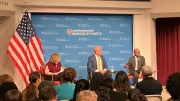
The January 22 conference “Making Democracy Interesting: Tips from TV, Podcasts, Science Fiction, and Online Creators,” hosted by the Harvard Kennedy School’s Ash Center for Democratic Governance and Innovation and organized by the Allen Lab for Democratic Renovation, focused on the ways storytelling might reshape and broaden an understanding of democratic life, especially for Gen Z Americans (the cohort born between 1997 and 2012, which forms 18 percent of the U.S. labor force, according to an August 2024 Department of Labor report). Moderated by Conant University professor Danielle Allen, the conversation brought scholars together with creators working in social media and podcasting, writers, television producers, and more.
Panelists argued that those realms often feel more accessible than traditional political discourse. In large part, they attributed this to the power of parasocial relationships in which a person feels a strong, intimate connection with a media figure (celebrity, influencer, or fictional character) who is unaware of their existence.
As Matt Fitzgerald, the founder of digital agency Fitz Partners and co-founder of #TeamWater (a massive creator-led fundraising campaign, launched in 2025 and co-led by YouTubers MrBeast and Mark Rober), explained, “If you spend enough time listening to someone [or watching them] on a screen, you start to think of them as your friend.” This dynamic extends across platforms, he said. From “the podcast host who has hours of your week” to “the streamer who may be telling you what’s going on in the news,” these figures can become trusted voices.
“With that comes a lot of responsibility and a lot of power,” Fitzgerald said, “and generally, that power has not been sufficiently examined.” In academia, he argued, the possibilities of platforms like social media—and that intimate connection with individual users that social media enables—has remained largely unexplored as a driver of democratic engagement.
Gideon Lichfield, a 2025–26 democracy renovation fellow at the Allen Lab and the former editor-in-chief of WIRED, echoed this concern. Since leaving that magazine in August 2023, Lichfield has focused on pushing democracy into the public imagination. The prevailing discourse around democracy, he argued, is vague and inaccessible, leaving many people unable to articulate what a “better” democracy might look like. He suggested, however, that a growing ecosystem of writers and creators working across fiction, podcasts, video, and social media are making democratic concepts more engaging— and offering imaginative ways for audiences to engage with self-governance.
Author Kim Stanley Robinson offered one example through his 2020 novel The Ministry for the Future, which envisions a near-future response to climate catastrophe. The book centers on a group of central bankers coordinating global climate mitigation. Robinson suggested that readers were hungry for a story that explored climate change and political responses to it without feeling entirely like fantasy.
Structured through multiple perspectives, including fictional essays and eyewitness accounts, the novel depicts democracy indirectly, “at an angle,” Robinson said. Rather than focusing on elections or institutions, the narrative emphasizes collective action. Characters operate as a chorus of voices working at local, regional, and global levels.
Robinson extended this idea with a real-world example from Taiwan, shared with Robinson in earlier conversations by former digital minister Audrey Tang. Taiwan has been expanding the use of machine learning in civic participation since the country launched the Pol.is in 2015, a software platform designed for crowdsourcing opinions and ideas. Since 2024, the country has begun using large language models (LLMs) to advance the same efforts. Randomly selected citizens (similar to jurors) are convened to deliberate on public problems. Discussions are then synthesized, with the help of AI, into legislative proposals that Taiwan’s parliament has agreed to formally consider “as if by another legislator.”
“This is not exactly direct democracy,” Robinson said, “it’s, again, representative—but it’s damned interesting, because suddenly, ordinary people are able to talk about what they don’t like about government, how to fix it, and then, crucially, the legislature had agreed to consider these as bills to be voted up or down.” Robinson described the process as a “science fiction story that already exists in the world.”
Dillon St. Bernard, a social impact strategist and the founder of Team DSB, a creative agency, focused on how the creator economy could help bridge democratic engagement gaps. Nonprofits and policy organizations frequently ask how to “get young people to care,” said St. Bernard, who works frequently with Gen Zers. Instead, he suggested, the better question is how institutions are allowing people to actually enter the conversation.
The creator economy, he argued, represents one viable on-ramp. “These creators have existing platforms [and are] ready to amplify [ideas],” St. Bernard said. His work involves giving creators the context and information they need to translate democratic concepts to their audiences in ways they would “say things naturally.”
Taken together, the panelists suggested a familiar idea: democracy may have its future not just in policies, but in the many forms of media we all consume.